





The Old Engine: Cross-Subsidies and Congestion
For decades, Indian Railways has operated on a model of cross-subsidisation, where profits from freight services are used to cover losses from passenger travel. This has kept passenger fares low but has come at a steep cost for the logistics sector. Freight
tariffs in India are among the highest in the world, a direct consequence of this policy. This financial pressure is compounded by immense infrastructural strain. Many of India’s high-density rail routes are operating far beyond their ideal capacity, some at over 150%. This congestion leads to slower transit times for goods, reduced windows for essential maintenance, and an overall lack of reliability that forces businesses to turn to the more expensive and less eco-friendly road transport network. As a result, rail's share in India's total freight movement has dramatically fallen over the decades, even though it remains a more cost-effective mode of transport per tonne-kilometre.
A New Track: The Economic Imperative for Freight
India’s ambition to become a global manufacturing hub and achieve a $5 trillion economy is directly tied to the efficiency of its supply chains. Logistics costs in India are estimated to be around 14% of the GDP, a figure significantly higher than in many developed nations. Bringing this cost down to a global benchmark of around 9% could save the economy billions. The National Rail Plan (NRP) acknowledges this, setting an ambitious goal to increase rail's modal share in freight to 45% by 2030. Achieving this requires a fundamental shift in perspective. Freight can no longer be viewed as simply a revenue source for the passenger segment. It must be treated as a strategic pillar of economic growth. A modern, efficient freight railway is essential for the success of initiatives like 'Make in India' by ensuring raw materials reach factories and finished goods reach ports and markets quickly and affordably.
Building the Future: Dedicated Freight Corridors
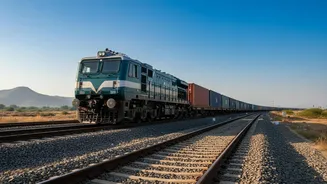
The most significant step towards this new future is the development of Dedicated Freight Corridors (DFCs). These are high-speed, high-capacity railway lines built exclusively for goods transport. The operational Eastern and Western DFCs are already showing transformative impact, enabling heavier, longer, and faster trains, which reduces transit times and improves reliability. The government is pushing forward with more, including the newly announced East-West DFC, which will connect mineral-rich eastern states with industrial western hubs. These corridors are being designed to handle heavier loads and feature advanced signalling and no level crossings to ensure higher throughput. By separating freight from the congested passenger network, DFCs allow goods trains to run on a predictable timetable, a crucial factor for modern supply chain management.
Beyond Tariffs: A Call for Holistic Review
Simply raising freight tariffs to meet revenue targets is a short-term fix that undermines long-term goals. A genuine review of goods movement must look beyond pricing. It requires an integrated strategy that includes accelerating the completion of all planned DFCs, investing in multimodal logistics parks to solve first- and last-mile connectivity issues, and adopting digital technologies for better tracking and operational efficiency. Encouraging private sector participation, perhaps through Public-Private Partnership (PPP) models as being considered for the East-West DFC, can bring in much-needed capital and operational expertise. The goal should not be just to move more tonnes, but to create a seamless, predictable, and competitive logistics ecosystem where rail is the natural choice for a wide range of commodities, not just bulk goods like coal.