



An Abrasive, Clinging Menace
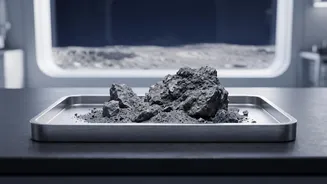
Moon dust, or regolith, is nothing like the soil on Earth. With no wind or water to smooth its edges, lunar regolith is composed of tiny, sharp, jagged particles akin to microscopic shards of glass. This material is the product of billions of years of micrometeorite
impacts that have pulverized the lunar rock. Its abrasive nature can wear down surfaces, scratch optical lenses on cameras, and degrade protective coatings. During the Apollo missions, astronauts found that the dust ground down their space suits and clogged seals, posing a significant risk. For a robot intended to operate for years, this constant wear and tear is a primary engineering challenge.
The Problem of Sticking Around
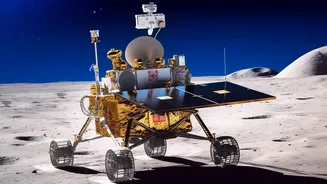
Beyond its sharpness, lunar dust is electrostatically charged by the constant bombardment of solar radiation. This charge makes it incredibly sticky, causing it to cling tenaciously to every surface it touches, from solar panels to mechanical joints. A thick layer of dust on solar panels can drastically reduce power generation, potentially crippling a robot's ability to function. When dust coats radiators, it acts as an insulator, preventing the robot from shedding excess heat and leading to overheating. The fine particles can also work their way into gears, bearings, and other moving parts, causing them to seize up and fail. China's Yutu rover's mission was likely compromised by lunar dust, serving as a stark reminder of the danger.
Surviving Extreme Temperature Swings
The Moon's lack of a significant atmosphere means it cannot retain heat. As a result, surface temperatures swing dramatically between day and night. During the long lunar day, temperatures can soar to 127°C (260°F). Then, during the two-week-long lunar night, they can plummet to -173°C (-280°F). In permanently shadowed craters near the poles, where water ice is believed to be trapped, temperatures can be even colder, dropping below -248°C (-414°F). These extreme thermal cycles put immense stress on all materials and components. Metals can become brittle, lubricants can freeze, and batteries can fail to hold a charge in the intense cold. For a robot to survive, it needs a robust thermal management system.
Engineering for Survival
Engineers are developing several strategies to combat these challenges. To fight dust, designs include tightly sealed joints, protective bellows, and specialized coatings. One of the most promising technologies is the Electrodynamic Dust Shield (EDS), which uses an invisible, moving electric field to lift charged dust particles off surfaces and cast them away. This system can keep solar panels and camera lenses clean without any moving parts. For thermal management, robots require a combination of solutions. Multi-layer insulation helps shield components from the extremes. During the day, radiators are needed to reject heat, while at night, electrical heaters are required to keep critical electronics and batteries above their minimum survival temperatures. Advanced passive systems, like thermal switches that can turn heat flow on or off, are also in development to help robots survive the long, cold lunar night with minimal power.