







A New National Address in Orbit
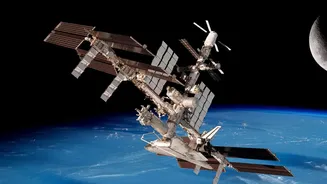
The Bharatiya Antariksh Station (BAS) is India’s answer to the final frontier—a permanent, modular space station orbiting about 400 kilometres above Earth. Envisioned as a key pillar of India's 'Space Vision 2047', the project is a monumental leap from
short-term missions to establishing a sustained human presence in space. The plan involves launching the first of five modules by 2028, with the entire 52-tonne station assembled and operational by 2035. This orbital outpost, operated by ISRO, is designed to house three to four astronauts for missions lasting three to six months. More than just a structure in low-Earth orbit, BAS is a statement of intent, positioning India to join the exclusive club of nations that have operated their own space stations.
The Ultimate Laboratory for Science
For the scientific community, the BAS is a game-changer. For decades, Indian researchers have had to rely on securing precious and often limited slots on foreign platforms like the International Space Station for microgravity experiments. An indigenous station provides a dedicated, long-term laboratory to probe questions that can only be answered in space. Scientists are eager to conduct advanced research in life sciences, studying the effects of long-term spaceflight on the human body, such as muscle atrophy and bone density loss. This is crucial for future deep-space missions. Other fields set to benefit include materials science, medicine, and biotechnology, allowing for breakthroughs in drug development and the creation of novel materials in a zero-gravity environment.
Opening for Business, 400km Up
The hum of anticipation is just as loud in the industrial sector. The Indian government has made it clear that the future of Indian space is a public-private partnership. The BAS is the centerpiece of a strategy to grow India’s share of the global space economy from its current 2-3% to a target of 10%. The project is expected to be a massive driver for high-tech manufacturing, creating opportunities for Indian companies in everything from life support systems to robotics. ISRO has already invited expressions of interest from private firms for constructing station modules. Beyond its construction, the station opens up commercial avenues previously unavailable to Indian enterprise, including in-orbit satellite servicing, space tourism, and leasing research time to private companies and even other nations.
Building Bridges to the Moon and Beyond
The Bharatiya Antariksh Station is not a final destination but a critical stepping stone. Mastering the technologies required to build and operate it—such as in-orbit docking, refueling, and advanced life support—is fundamental for India's grander ambitions. The entire project builds on the foundation of the Gaganyaan human spaceflight programme, which must first prove its reliability. The experience gained from long-duration missions on the BAS will directly feed into the plan to land an Indian astronaut on the Moon by 2040 and prepare for eventual interplanetary journeys. Therefore, the station is best understood as a bridge connecting India’s current capabilities with its lunar and deep-space future, turning today’s science fiction into tomorrow’s reality.