
India's Next Great Space Adventure
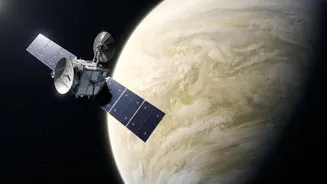
Following the historic successes of the Chandrayaan moon missions and the Mangalyaan Mars orbiter, ISRO is setting its sights on our other planetary neighbour. The Shukrayaan mission, formally the Venus Orbiter Mission, represents India's first dedicated
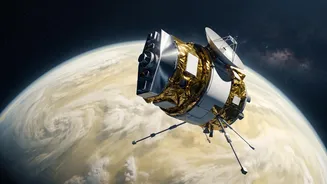
journey to Venus. Approved by the Union Cabinet, this ambitious project aims to place a sophisticated orbiter into a unique elliptical path around the planet. The spacecraft will carry a suite of scientific instruments, weighing around 100 kg, designed to conduct a comprehensive study of Venus from above. The mission is a testament to India's growing capabilities in interplanetary exploration, building on previous triumphs to tackle one of the most challenging environments in our solar system.
The Scientific Toolkit for a Hostile World
The key to Shukrayaan's success lies in its advanced sensor payload, which is currently being prepared and finalised. These instruments are designed to peer beneath the planet's thick, toxic clouds and analyse its complex atmospheric behaviour. One of the flagship instruments is a high-resolution Synthetic Aperture Radar (SAR). Unlike optical cameras, SAR can map the Venusian surface in incredible detail, penetrating the dense sulfuric acid clouds to reveal volcanoes, craters, and other geological features. Another critical instrument is the Venusian Neutrals Analyser (VNA), developed in collaboration with Sweden, which will study how the solar wind interacts with the planet's upper atmosphere. This suite of sensors will provide a multi-faceted view of Venus, from its hidden surface to the dynamics of its ionosphere.
Why Study Venus's Atmosphere?
Understanding the atmospheric dynamics of Venus is a primary objective for Shukrayaan. Venus has a runaway greenhouse effect, resulting in surface temperatures hot enough to melt lead, and an atmosphere so dense the pressure is over 90 times that of Earth's at sea level. Scientists are keen to understand the 'super-rotation' of its atmosphere, where winds whip around the planet much faster than the planet itself spins. By studying these extreme dynamics, researchers hope to gain insights into planetary climate models. This could even help us better understand the long-term evolution of Earth's own climate. Studying how Venus lost its potential early habitability and became a scorching hothouse serves as a critical cautionary tale for our own world.
A Precise Timeline for an Interplanetary Journey
Precision is everything in space travel. ISRO has scheduled the launch of Shukrayaan for March 29, 2028, aboard its powerful LVM-3 rocket, the same launch vehicle that successfully sent Chandrayaan-3 to the Moon. This launch window is carefully chosen to ensure the most efficient trajectory. The spacecraft is expected to embark on a 112-day journey before arriving at its destination. On July 19, 2028, the orbiter will perform a crucial orbital insertion manoeuvre, placing it into a highly elliptical orbit around Venus. This orbit, ranging from 500 km at its closest approach to 60,000 km at its farthest, is ideal for the mission's diverse scientific objectives, allowing instruments to gather data from various altitudes over a planned four-year operational period.
India's Role in the Global Return to Venus
ISRO's mission is part of a renewed global interest in Venus. After decades of being relatively overlooked in favour of Mars, several space agencies, including NASA with its DAVINCI and VERITAS missions, are planning to return to the cloud-covered planet. Shukrayaan places India firmly in this new era of Venusian exploration. The mission not only showcases indigenous technological prowess but also fosters international collaboration, with payloads from Sweden and potential cooperation with France. By contributing its own unique data, Shukrayaan will be a vital piece in the global effort to solve the enduring puzzles of Earth's enigmatic twin.