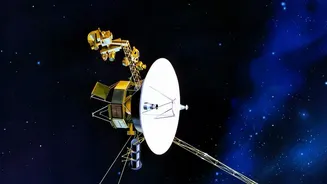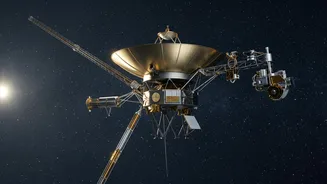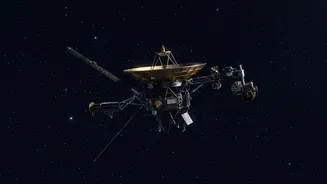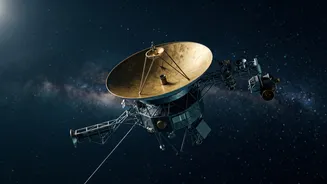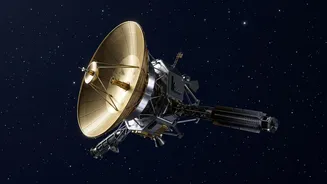



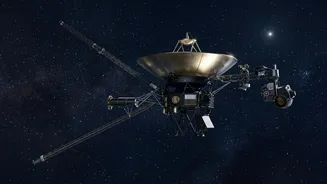
Launched nearly 50 years ago, NASA's Voyager 1 is humanity’s farthest emissary to the cosmos. Now, this intrepid explorer is about to cross a mind-boggling new milestone, reaching a distance that is measured not in miles, but in the speed of light.
A Journey of One Light-Day
On
November 18, 2026, a machine built by human hands will achieve something unprecedented: it will be one light-day away from its home planet. A light-day is the distance light travels in a vacuum in 24 hours, a staggering 25.9 billion kilometres. To put that into perspective, sunlight takes just over eight minutes to reach Earth, and the most distant planet in our solar system, Neptune, is about four light-hours away. For Voyager 1, this means any signal sent from NASA’s Deep Space Network will take a full 24 hours to reach it, and another 24 hours for a response to travel back. The 48-hour round trip is a stark reminder of the immense void the spacecraft has crossed since its launch.
A Grand Tour and Beyond
Voyager 1 began its journey on September 5, 1977, launched 16 days after its twin, Voyager 2. Its primary mission was a 'Grand Tour' of the outer planets. It swung past Jupiter in March 1979, revealing a thin ring system and the shocking discovery of active volcanoes on its moon, Io—the first ever found beyond Earth. In November 1980, it encountered Saturn, studying its complex rings and making a close flyby of the hazy moon Titan. After that, its planetary mission was complete. Its trajectory bent northward, sending it out of the plane of the solar system and on a one-way trip toward the stars. In 2012, it officially entered interstellar space, becoming the first human-made object to leave our sun's protective bubble, the heliosphere.
An Unexpected Silence
Even at nearly 50 years old, the mission continues to present new challenges. Just last month, in October 2026, the venerable probe gave its engineers a scare. For 48 hours, during two scheduled check-ins, Voyager 1 fell silent. Mission control at NASA’s Jet Propulsion Laboratory received no signal. Then, as mysteriously as it stopped, the signal returned on October 20. An investigation revealed the spacecraft's onboard computer had automatically switched to a backup set of thrusters after detecting an issue, a pre-programmed safety measure. While engineers are still investigating the root cause, the incident highlighted the resilience of the 1970s technology and the ingenuity of the team managing it from billions of kilometres away.
Keeping a Legend Alive
The recent communication glitch is just one of many hurdles the team has faced. The spacecraft's power source, a set of radioisotope thermoelectric generators, loses about four watts of power each year as its plutonium fuel decays. To conserve energy, engineers have been methodically shutting down non_essential systems and instruments. In September 2026, they performed a complex maneuver nicknamed the 'Big Bang', swapping several heating units for more energy_efficient alternatives to prolong the life of the remaining science instruments. Thanks to these efforts, Voyager 1 continues to send back invaluable data from interstellar space using its two remaining active instruments, a magnetometer and a plasma wave detector.