






A Snapshot from the Dawn of Time
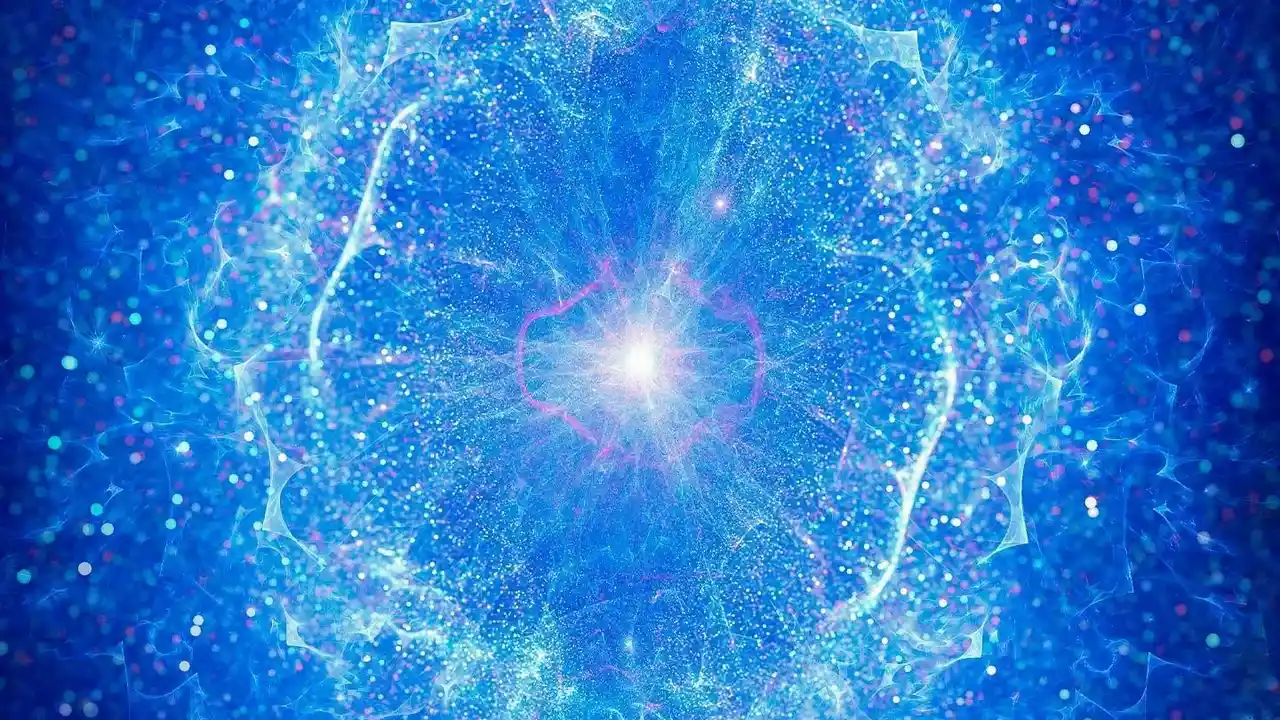
Imagine being able to see the universe just 380,000 years after the Big Bang. That’s essentially what the Cosmic Microwave Background (CMB) allows us to do. Before this time, the universe was a superheated, dense plasma where light was constantly scattered,
unable to travel freely. Once it cooled enough for atoms to form, space became transparent, and this first light was released. For 13.8 billion years, it has been travelling across the cosmos, cooling and stretching until it now exists as a faint microwave glow in every direction we look. This CMB is not perfectly uniform; it has minuscule temperature variations that represent the seeds from which all galaxies and cosmic structures eventually grew. By studying this primordial light, we get a direct look at the conditions of the infant universe.
The (Almost) Perfect Theory of the Cosmos
Our current best understanding of the universe is called the Lambda-CDM model, or the Standard Model of Cosmology. This framework has been stunningly successful, explaining everything from the existence of the CMB to the large-scale distribution of galaxies. It tells us the universe is made of about 5% ordinary matter (the stuff we see), 27% mysterious 'dark matter', and 68% even more mysterious 'dark energy' driving cosmic expansion. However, the model is incomplete. It doesn't tell us what dark matter or dark energy actually are, nor does it fully explain why there is so much more matter than antimatter. These deep puzzles are why physicists are actively searching for 'new physics'—phenomena that lie beyond this standard framework.
Searching for a Cosmic Twist
One of the most exciting new frontiers in this search involves the polarization of the CMB light—essentially, the orientation of the light waves. According to the Standard Model, the universe should obey a fundamental rule called parity symmetry, meaning it shouldn't have a built-in 'handedness' or preference for 'left' over 'right'. A process and its mirror image should be indistinguishable. A violation of this symmetry would leave a specific signature in the CMB known as 'cosmic birefringence', causing the plane of polarization to rotate slightly as it travels through space. Finding such a twist would be a smoking gun for new physics, proving that some unknown particle or force was at play in the early universe. Recent analyses of data from telescopes like the Planck satellite and the Atacama Cosmology Telescope have found intriguing hints of this effect, though the results are not yet statistically significant enough to be declared a discovery.
What Could This New Physics Be?
If this cosmic twist is confirmed, what could be causing it? The leading theories suggest it could be the work of a previously unknown field that pervades the universe, possibly related to dark energy or dark matter. One candidate is a type of hypothetical particle called an 'axion' or an 'axion-like particle'. Such particles, if they exist, could solve several cosmological mysteries at once, including the nature of dark matter and problems within the Standard Model of particle physics. Detecting this parity violation would give scientists their first real handle on these elusive phenomena, opening up an entirely new chapter in our understanding of the universe's fundamental components. Future, more sensitive observatories like the Simons Observatory in Chile and the upcoming SPT-3G+ camera at the South Pole are being designed to make precisely these kinds of measurements, hoping to turn today's hints into tomorrow's discoveries.