



The Universe’s Ultimate Speed Limit
The secret to this cosmic time travel is a simple but profound fact: light, though incredibly fast, does not travel instantaneously. It moves at a constant speed of about 3,00,000 kilometres per second. That’s fast enough to circle the Earth more than
seven times in a single second. But space is vast—impossibly, mind-bogglingly vast. Because of these colossal distances, the light from celestial objects takes time to reach us. The farther away an object is, the longer its light has been travelling, and the further back in time we are seeing it. So, when you look up, you’re not seeing the stars as they are 'now,' but as they were when their light began its journey to your eyes.
A Trip Around Our Neighbourhood
Let’s start close to home. The Moon is our nearest celestial companion, orbiting at an average distance of about 3,84,400 kilometres. The light you see reflecting off its surface takes approximately 1.3 seconds to reach you. So, when you look at the Moon, you’re seeing it as it was 1.3 seconds ago. It's a tiny blip in time, but it’s still the past. The Sun is much farther, about 150 million kilometres away. The light from our star takes around 8 minutes and 20 seconds to travel to Earth. This means if the Sun were to suddenly vanish, we wouldn’t know about it for over eight minutes. Every sunrise is an 8-minute-old memory.
Meeting the Stellar Neighbours
Now, let’s venture to the stars. The closest star system to us, Alpha Centauri, is about 4.2 light-years away. A light-year is the distance light travels in one year—a staggering 9.5 trillion kilometres. When you see Proxima Centauri, the closest star in that system, you are seeing light that left its surface over four years ago. Think about what you were doing four years ago; that’s when the light you see tonight started its journey. The brilliant star Sirius, the brightest in our night sky, is about 8.6 light-years away. You're seeing it as it was nearly a decade in the past. Every star in the sky is a snapshot from a different point in history.
Looking Across Our Own Galaxy
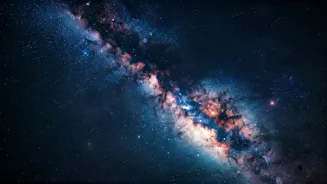
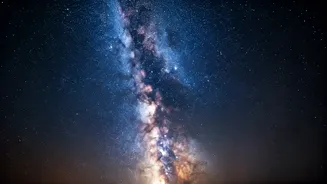
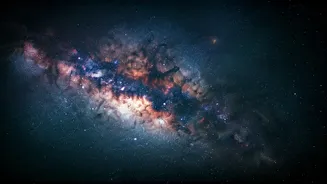
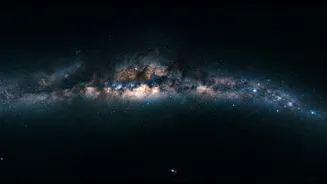
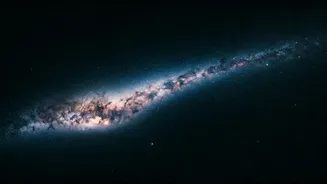
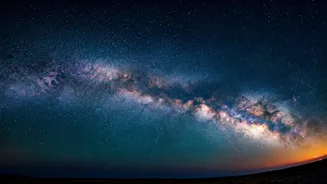
Our home, the Milky Way galaxy, is a sprawling disc of stars, gas, and dust roughly 1,00,000 light-years across. When you look towards the dense, bright centre of the Milky Way—a beautiful sight from a dark spot in India—you are seeing light that has travelled for 25,000 to 30,000 years. That light began its journey around the time early humans were painting in caves. We are separated from the heart of our own galaxy not just by distance, but by a chasm of 30 millennia.
Gazing at Ancient Islands of Light
This effect becomes truly mind-bending when we look beyond our own galaxy. On a clear, dark night, far from city lights, you can spot a faint, fuzzy patch in the sky. That is the Andromeda Galaxy, our nearest major galactic neighbour. It’s about 2.5 million light-years away. The photons hitting your retina from Andromeda tonight left that galaxy 2.5 million years ago. At that time, early human ancestors like *Homo habilis* were roaming Africa. Modern humans did not yet exist. You are looking at an object so far away that its light has been travelling towards you for the entire history of our species, and then some.
The Universe's Baby Pictures
Astronomers use this principle as their primary tool for studying cosmic history. Powerful instruments like the Hubble and James Webb Space Telescopes are designed to be time machines. They peer into the deepest corners of the cosmos, capturing light from galaxies that are billions of light-years away. By doing this, they can see the universe as it was in its infancy, just a few hundred million years after the Big Bang. They are essentially watching the first galaxies form, giving us a direct look at the 'baby pictures' of our universe. Every deep-field image from these telescopes is a portrait of the distant past.