


The Old Way: The Burden of Chemical Fuel
For decades, satellites have navigated orbit using chemical thrusters. Think of them as a series of small, controlled explosions. They burn liquid fuel and an oxidiser to produce a powerful push, allowing satellites to adjust their position or move into
their final orbit. This method is reliable and provides strong thrust, but it has a major drawback: weight. A significant portion of a satellite's launch mass is just fuel. For example, a conventional 5,000 kg communication satellite might need to carry over 900 kg of chemical propellant. This fuel is heavy, bulky, and once it runs out, the satellite's ability to manoeuvre is gone, effectively ending its operational life, even if its scientific instruments are still working perfectly.
A New Kind of Push: Enter Electric Propulsion
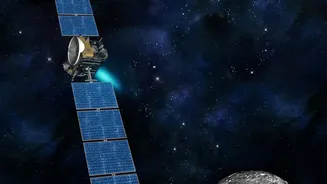
Electric propulsion systems, including plasma thrusters, offer a revolutionary alternative. Instead of relying on chemical combustion, they use electrical power—typically generated by the satellite's solar panels—to accelerate a propellant and generate thrust. The key advantage is incredible efficiency. While the push, or thrust, is much gentler than a chemical rocket's blast, it can be sustained for very long periods. It’s the classic tortoise-and-the-hare story: a chemical thruster provides a powerful sprint, while a plasma thruster provides a steady, marathon-like push that, over time, achieves massive changes in velocity with a fraction of the fuel.
The Science Behind the Gentle Push
So, how do you turn electricity and a gas into thrust? The most common type of plasma thruster used is a Hall-effect thruster. It works by feeding a small amount of an inert gas, like xenon, into a chamber. Inside, an electric field strips electrons from the xenon atoms, turning the gas into plasma—an electrically charged fourth state of matter. A magnetic field then traps these electrons, which in turn helps accelerate the heavier, positively charged xenon ions out of the thruster at incredibly high speeds, sometimes over 30 kilometres per second. According to Newton's third law, this high-speed ejection of ions creates an equal and opposite reaction, gently pushing the satellite forward. An external cathode then neutralizes the ion beam to prevent the satellite from building up an electric charge.
Lighter Loads, More Science
The most immediate benefit of this technology is a massive reduction in weight. Plasma thrusters are five to six times more fuel-efficient than their chemical counterparts. This means a satellite needs to carry significantly less propellant. An ISRO official noted that for some missions, the fuel requirement could drop from nearly 1,000 kg to just a few hundred kilograms. This weight saving has a cascading effect. A lighter satellite can be launched on a smaller, less expensive rocket. Alternatively, the weight saved on fuel can be reallocated to more valuable hardware, such as additional transponders on a communication satellite or more advanced scientific instruments, effectively allowing a smaller satellite to do the job of a much larger, conventional one.
Going the Distance: A Longer Life in Orbit
Besides saving weight, the supreme fuel efficiency of plasma thrusters directly translates to a longer mission duration. A satellite's life in geostationary orbit, about 36,000 km above Earth, is a constant battle against gravitational pulls from the Earth, Sun, and Moon. Tiny, regular orbital adjustments, known as 'station-keeping', are essential to keep it in the right spot. With chemical thrusters, the fuel allocated for these manoeuvres eventually runs out, forcing the satellite's retirement after 12-15 years. Because plasma thrusters sip their propellant, they can perform these station-keeping operations for a much longer time, extending a satellite's useful life by many years and maximizing the return on a multi-crore investment.
ISRO's Plasma-Powered Future
ISRO has been strategically embracing this technology to enhance its capabilities. The space agency first demonstrated an electric propulsion system on the GSAT-9 satellite in 2017, though the core thruster was imported. Since then, ISRO's Liquid Propulsion Systems Centre (LPSC) has been developing its own thrusters. The organisation has successfully completed long-duration tests on its indigenously developed Stationary Plasma Thruster (SPT), a major step towards self-reliance. Future missions, like the Technology Demonstration Satellite (TDS-01), are planned to feature these Made-in-India systems, paving the way for a new generation of all-electric ISRO satellites for communication and deep-space exploration. While the low thrust means it takes longer for satellites to reach their final orbit, the long-term benefits are undeniable.