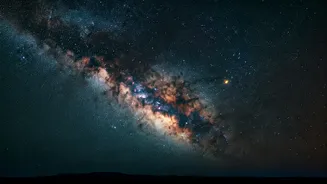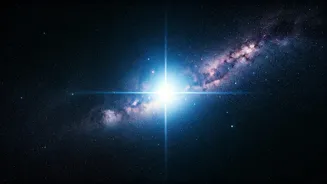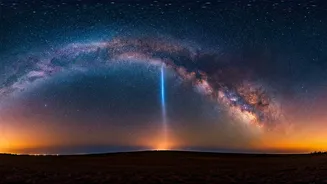




Your Eyes are a Time Machine
It sounds like science fiction, but it’s the most fundamental truth of astronomy. When you look at a distant object, you are seeing the light that left it long ago. This is because light, while incredibly fast, does not travel instantaneously. It moves
at a finite speed: about 2,99,792 kilometres per second. For things on Earth, this delay is unnoticeable. But in the vastness of space, the distances are so immense that light can take years, centuries, or even millions of years to reach our eyes. Think of it like receiving a letter from a friend overseas. The letter tells you what they were doing a week ago, not what they are doing right now. The night sky is the same, but on a cosmic scale. Every single star is a postcard from the past. The farther away the star, the older the message we are receiving.
The Meaning of a Light-Year
To measure these cosmic distances, astronomers use a unit called a light-year. It's not a measure of time, but of distance. One light-year is the distance light travels in one year, which is a staggering 9.46 trillion kilometres. Our closest stellar neighbour, Proxima Centauri, is about 4.2 light-years away. This means the light we see from it tonight actually left the star over four years ago. We are seeing Proxima Centauri as it was during the latter half of 2020. If it were to suddenly explode today, we wouldn't know about it for another four years.
The Sun itself is about 8.3 light-minutes away. So even our own star, the centre of our solar system, is always viewed with an eight-minute delay. The sunlight warming your face right now left the Sun before you probably finished your morning chai.
So, Are All the Stars We See Dead?
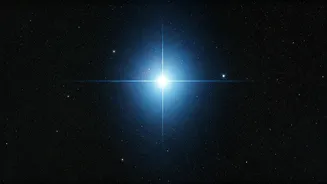
Here's where we need to add some important nuance. The poetic idea that the night sky is a graveyard is a powerful one, but it's not entirely accurate. Most of the individual stars you can see with your naked eye are part of our own Milky Way galaxy and are relatively close, astronomically speaking. Stars like Sirius (8.6 light-years away), Vega (25 light-years), and Altair (17 light-years) are our galactic neighbours.
Given that a typical star lives for billions of years, the chances that any of these nearby stars have died in the few years or decades it took their light to reach us are incredibly slim. So, you can rest assured that the vast majority of the bright, familiar stars in constellations like Orion or Ursa Major are very much alive and shining.
Where the Headline Becomes True
The headline's claim becomes more plausible when we look much, much farther away. Take a star like Eta Carinae, located over 7,500 light-years from Earth. Its light takes 7,500 years to reach us. It's a massive, volatile star expected to explode in a supernova sometime in the 'near' cosmic future. Has it already exploded? It's possible. We could be looking at a stellar ghost, and the wave of light from its spectacular death is still hurtling through space towards us.
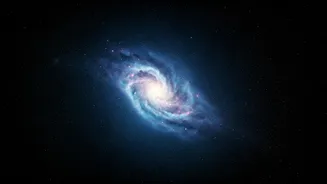
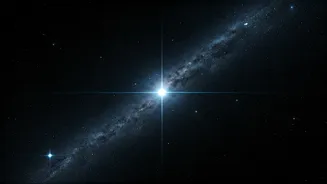
And when we look beyond individual stars to entire galaxies, the time-travel effect becomes truly mind-bending. The Andromeda Galaxy, the closest major galaxy to our own, is 2.5 million light-years away. The light we see from it tonight is 2.5 million years old. When that light began its journey, modern humans did not yet walk the Earth. We are looking at an ancient version of our galactic neighbour. For galaxies that are billions of light-years away, we are seeing them as they were in the universe's infancy, and countless stars within them have certainly lived and died since.