




Sailing on Sunshine
At its core, a solar sail works much like a sailboat on water, but the physics are far more delicate. Instead of wind, a solar sail catches the constant stream of photons flowing from the sun. These tiny packets of light have no mass, but they possess
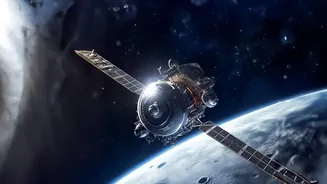
momentum. When billions of them bounce off a large, ultra-thin, reflective sail, they transfer that momentum, giving the spacecraft a gentle but continuous push. Because the sun is always shining, this propulsion method requires no heavy, expensive, or finite chemical propellant. This makes it an ideal solution for small, low-cost spacecraft, such as CubeSats, which can be packed with scientific instruments instead of fuel tanks. Over time, this constant, tiny acceleration can build up to incredible speeds, potentially enabling missions that are currently impossible or prohibitively expensive with traditional rockets.
The Challenge of Steering
Simply being pushed by sunlight is one thing; navigating to a specific destination millions of kilometres away is another challenge entirely. Early solar sail concepts focused primarily on generating thrust. But like a ship needing a rudder, a solar sail probe needs a way to steer. This is accomplished by tipping and tilting the sail to change the angle at which sunlight hits it. By carefully adjusting the orientation, mission controllers can alter the direction and magnitude of the thrust, allowing the spacecraft to spiral away from or toward the sun, or change its orbital plane. This method, however, can be slow and requires complex calculations and precise mechanical control. Missions like The Planetary Society's LightSail 2 successfully demonstrated controlled solar sailing in Earth orbit, proving the concept's viability.
The Navigation Breakthrough
Recent advancements are less about the sail itself and more about the materials and control systems that make navigation more efficient and precise. One key area of development is in the composite booms that deploy and support the massive, yet gossamer-thin, sails. NASA's Advanced Composite Solar Sail System (ACS3) mission, launched in 2024, is testing booms made of new lightweight materials that are more rigid and less prone to warping under extreme temperatures. Lighter, more stable booms allow for larger sails and more precise attitude control, making it easier to execute the subtle adjustments needed for interplanetary navigation. These new systems, combined with advanced software for trajectory optimization, represent the breakthrough needed to move from demonstrating the technology to using it for targeted scientific missions.
Destination: Near-Earth Asteroids
So why are near-Earth asteroids (NEAs) the perfect target for this technology? NEAs are scientifically valuable time capsules from the formation of our solar system, and some also pose a potential impact threat to Earth. Understanding their composition is crucial for both science and planetary defense. However, they are often small, irregularly shaped, and in tricky orbits. A solar-sail-powered probe, being lightweight and propellant-free, can undertake long-duration, flexible missions to rendezvous with these objects. It can perform slow flybys, allowing high-resolution cameras to map the asteroid's surface, size, and shape in detail—something a faster, fuel-limited probe might struggle to achieve. NASA's NEA Scout mission, which launched with Artemis I, was designed specifically for this purpose, aiming to visit the smallest asteroid ever studied. Though contact with the spacecraft was lost, it established a critical blueprint for future low-cost asteroid reconnaissance.
The Future of Interplanetary Travel
The advancements in solar sail navigation are paving the way for a new class of ambitious missions. Beyond just observing asteroids, this technology could enable probes to hover at unique vantage points in space to monitor solar weather, act as communication relays for crewed missions to Mars, or even venture to the outer planets on much faster timescales. Concepts like the Solar Cruiser, a sail roughly the size of a basketball court, aim to mature the technology for these very applications. As engineers refine the materials and control systems, solar sails are transitioning from a novel idea to a workhorse technology, promising a future of more accessible and sustainable exploration of our cosmic neighbourhood and beyond.