




The Essential Ingredient
In the grand cosmic search for life beyond Earth, water is the headline act. It is the one ingredient considered essential for life as we know it, acting as a universal solvent that allows the complex chemical reactions of biology to occur. For decades,
astronomers have been hunting for its signature in the atmospheres of exoplanets—planets orbiting stars other than our sun. Finding it doesn't automatically mean finding life, but it’s a monumental step. The presence of water vapour tells scientists that a key building block for habitability exists. More than that, it provides a crucial window into a planet’s formation, history, and current climate. How water gets to a planet, whether it arrived via icy comets or was baked in from the start, is a central debate in planetary science. Each new detection of water on a distant world offers another piece of this intricate puzzle.
A Groundbreaking JWST Discovery
The James Webb Space Telescope (JWST) has been a game-changer in this field. One of its most exciting recent finds involves the PDS 70 system, located 370 light-years away. There, Webb detected water vapour in the inner, rocky-planet-forming zone of a young star’s protoplanetary disk. This was the first time water has been found in the terrestrial region of a disk already known to be forming planets. Scientists were surprised to find water in this relatively old, 5.4-million-year-old system, as the star's radiation is expected to break down water molecules over time. The discovery suggests that dust and other particles in the disk might be acting as a protective shield, preserving the water. This implies that if rocky, Earth-like planets are forming there, they will have access to water from the very beginning of their creation.
More Than Just Habitability
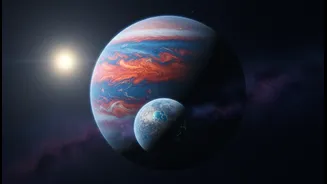
The insights gained from these discoveries extend far beyond the simple presence of water. For example, on the small exoplanet GJ 9827d, the detection of water vapour presents two fascinating possibilities about its past. One theory is that the planet is a 'mini-Neptune' with a hydrogen-rich atmosphere laced with water. The other is that it could be a hotter version of Jupiter's moon Europa, having formed farther from its star where water ice is abundant and then migrated inward. In this second scenario, the star's intense radiation would have stripped away its original lighter atmosphere, leaving behind a denser, water-rich one. Each possibility tells a completely different story about planetary migration and atmospheric evolution, showcasing the diverse pathways planets can take. It pushes science closer to understanding the prevalence of different types of atmospheres on rocky planets.
Unlocking Atmospheric Secrets
The technology that makes these discoveries possible is as revolutionary as the findings themselves. Using a technique called transit spectroscopy, telescopes like the Hubble and the JWST analyse the light from a star as an exoplanet passes in front of it. As the starlight filters through the planet's atmosphere, certain wavelengths are absorbed by the molecules present, leaving a unique chemical 'fingerprint'. This is how scientists can identify water, methane, carbon monoxide, and other gases from light-years away. In a recent discovery in the Beta Pictoris system, this spectroscopic technique not only confirmed a new planet but also immediately began revealing its atmospheric chemistry, including water vapour and methane. This method is transforming the search for new worlds from simply spotting a point of light to reading the very air of alien planets from the first observation.
The Challenge of Certainty
Despite the power of these new tools, the science is not without its challenges. In the case of the rocky exoplanet GJ 486 b, which orbits a cool red dwarf star, scientists detected what appears to be water vapour. However, they must be cautious. The signal could be coming from the planet's atmosphere, which would be a landmark discovery for a hot, rocky world. But an equally plausible explanation is that the water exists in cool spots on the star itself, which can mimic the signal of a planetary atmosphere. Distinguishing between these two sources is a major challenge that requires further observation with multiple instruments. This uncertainty highlights the meticulous work involved in planetary science. Every claim must be carefully vetted, as researchers push the boundaries of what can be detected across such vast distances.