
Spotting a Cosmic Tourist
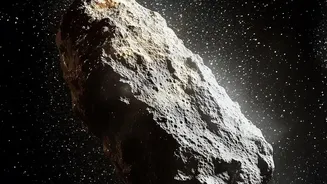
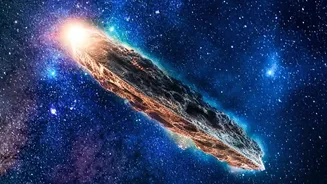
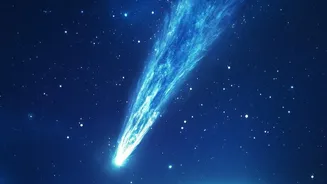
First, scientists have to find these interstellar travellers. So far, we've only confirmed a few, including the mysterious 'Oumuamua and the more conventional comet 2I/Borisov. These objects are incredibly faint and move at tremendous speeds. Their discovery
often relies on powerful survey telescopes that scan the entire sky repeatedly, looking for anything new or fast-moving. The key giveaway that an object is not from our solar system is its trajectory. Objects bound to our Sun travel in elliptical orbits. Interstellar visitors, however, are not gravitationally tied to our Sun. They travel on an open-ended path called a hyperbolic trajectory, moving so fast that they zip past the Sun and head back into deep space, never to return. Calculating this path is the first crucial step in identifying a comet as a genuine interstellar interloper.
Analysing the Message in the Light
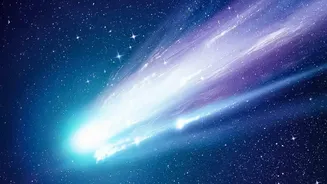
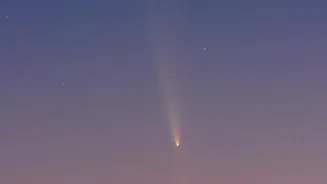
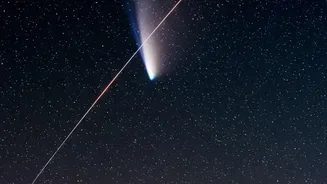
Once an interstellar comet is identified, it’s a race against time to study it before it fades from view. The primary tool for this is spectroscopy. As the comet gets closer to the Sun, its ice begins to turn into gas, a process called outgassing, which forms a glowing halo called a coma. By passing the light from this coma through a spectrometer, scientists can break it down into its constituent colours, revealing chemical fingerprints. This tells them what the comet is made of. For example, when astronomers studied 2I/Borisov, they were surprised to find an unusually high concentration of carbon monoxide gas compared to comets from our own solar system. This suggests it formed in an extremely cold region of its home star system, perhaps farther out than where our own comets were born.
Reading Clues from Dust and Size
Besides the gas, telescopes like the Hubble Space Telescope can observe the dust being shed by the comet. The amount of dust, its colour, and the shape of the tail provide clues about the comet's nucleus—its solid, icy core. While the nucleus itself is usually too small to see directly, the behaviour of the gas and dust allows scientists to estimate its size. For instance, observations of 2I/Borisov suggested its nucleus was relatively small, perhaps less than a kilometre in diameter. These physical characteristics, when compared with the thousands of comets from our own solar system, help paint a picture of how comets might form around other stars. While 2I/Borisov looked a lot like our own comets, its unique chemical makeup was a critical clue that it was indeed an alien visitor.
A Glimpse into Distant Worlds
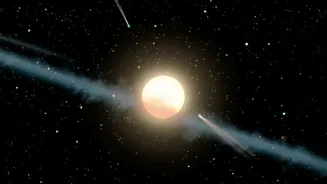
Studying interstellar comets is the closest we can get to sampling material from another solar system. These objects are essentially free probes sent to us from distant stars, carrying information about the building blocks of planets elsewhere in the galaxy. The composition of 2I/Borisov, rich in carbon monoxide, implies that the protoplanetary disk it came from may have been very different from our own. It was likely ejected from its home system billions of years ago, possibly after a close encounter with a giant planet. Each new discovery provides a data point that helps scientists understand the diversity of planetary systems in our galaxy. They are no longer limited to studying just one system—our own—to understand how planets are born.
The Future of Interstellar Detection
Until recently, finding these objects was a matter of luck. But a new generation of powerful observatories is set to change that. The Vera C. Rubin Observatory, scheduled to begin its decade-long survey in 2025, will scan the entire sky every few nights with unprecedented depth. Scientists predict it will discover dozens, if not hundreds, of interstellar objects. This will transform the field from the study of a few oddities into a statistical science, allowing astronomers to categorise different types of interstellar visitors and build a comprehensive picture of the small-body populations of our galaxy. With more visitors to analyse, we will gain deeper insights into the chemistry and dynamics of star systems far beyond our own.