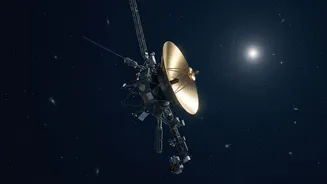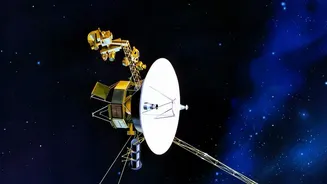

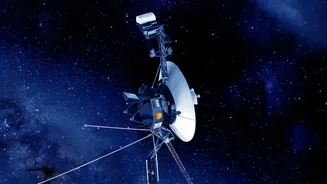
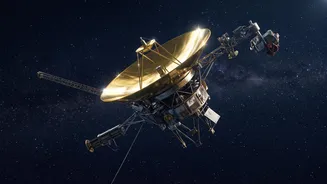
Launched when disco was still on the radio, NASA's Voyager 1 is about to hit a milestone that feels like science fiction. On November 18, it will be one light-day from Earth, a testament to nearly 50 years of relentless travel.
What is a Light-Day Anyway?
A light-day is not a measure
of time, but of immense distance. It is how far a beam of light, the fastest thing in the universe, travels in 24 hours. That equates to roughly 25.9 billion kilometres (or 16.1 billion miles). For perspective, that is about 173 times the distance between the Earth and the Sun. This means that on November 18, the radio signals from Voyager 1 will take a full 24 hours to reach the antennas of the Deep Space Network on Earth. Sending a command and receiving confirmation will become a two-day affair, a conversation held across a mind-boggling void.
A 49-Year Journey into the Unknown
Voyager 1 left Earth on September 5, 1977, 16 days after its twin, Voyager 2. Its original 'grand tour' mission was to study Jupiter and Saturn, which it did with spectacular success. It revealed the first active volcanoes beyond Earth on Jupiter's moon Io and explored Saturn's complex rings. After its Saturn flyby in 1980, a gravity assist flung it onto a trajectory out of the plane of the solar system at a blistering speed of over 60,000 km/h. In 1998, it surpassed Pioneer 10 to become the most distant human-made object. Then, in August 2012, it achieved its most historic feat: crossing the heliopause, the boundary where the Sun's solar wind gives way to the interstellar medium, officially entering the space between the stars.
An Aging Explorer's Health
Keeping a nearly 50-year-old spacecraft alive is a masterclass in engineering. Voyager 1 runs on a plutonium power source that decays over time, losing about four watts of power per year. To conserve energy, NASA has been systematically shutting down its instruments. Once equipped with a full suite of cameras and sensors, only two science instruments remain active today: the magnetometer and the plasma wave subsystem, which study the magnetic fields and plasma of interstellar space. The mission has also had recent scares. In October 2026, NASA briefly lost contact with the probe for 48 hours before the signal mysteriously returned. Engineers discovered a set of thrusters had automatically switched to its backup, a pre-programmed safety measure. These events are a stark reminder that while the mission continues, its operational margins are razor-thin.
Alone in Interstellar Space
Voyager 1 is currently in a region no other probe has ever directly sampled. Interstellar space is not an empty vacuum; it's a tenuous sea of gas, dust, plasma, and radiation from other stars. By crossing into this realm, Voyager confirmed that the density of cold particles outside our solar bubble is much higher than inside, a key prediction of astrophysical models. But it's important to note that while it has entered interstellar space, it has not truly left the solar system. The Sun's gravitational influence extends thousands of times farther, out to a theoretical shell of icy bodies called the Oort Cloud. Voyager 1 won't reach the inner edge of the Oort Cloud for another 300 years.
The Long Goodbye
The one-light-day milestone is purely symbolic for the spacecraft itself, which will pass the mark completely unaware. For its creators on Earth, however, it serves as a powerful moment of reflection. Ingenious power-saving maneuvers may keep at least one instrument running into the 2030s, but the mission has a finite lifespan. NASA estimates it will lose the ability to communicate with Voyager 1 entirely around 2036, when its signal becomes too faint for even the largest radio antennas to detect. After that, the probe will go silent forever, continuing its journey through the Milky Way as a silent ambassador from a world that sent it on its way decades ago. It will not approach another star for some 40,000 years, carrying its Golden Record—a message in a bottle thrown into the cosmic ocean.