


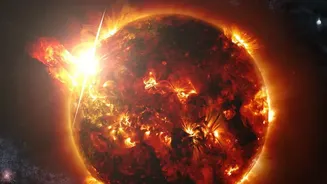
In a remarkable display of international teamwork, Indian and European space missions have joined forces to decode the secrets of the Sun's violent eruptions. A new study marks a major milestone for India's Aditya-L1 and its partnership with Europe.
Two Missions, One Shared Vision
At
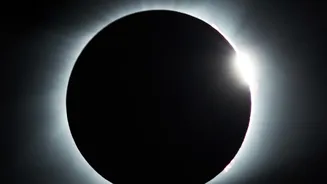
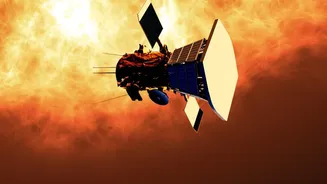
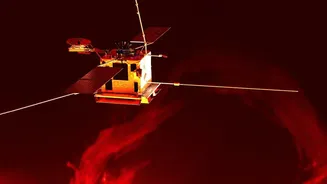
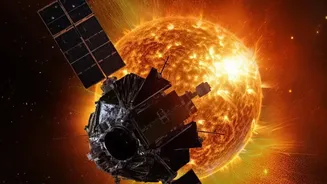
the heart of this collaboration are two highly sophisticated space missions: India's Aditya-L1 and the European Space Agency's (ESA) Proba-3. Aditya-L1, India's first dedicated solar observatory, was launched by ISRO in September 2023 and is positioned at a unique vantage point in space called Lagrange Point 1 (L1), allowing it to watch the Sun continuously. Its key instrument for this study is the Visible Emission Line Coronagraph (VELC), developed by the Indian Institute of Astrophysics (IIA). Proba-3, launched by an Indian PSLV rocket in December 2024, is a feat of engineering in itself. It consists of two spacecraft flying in perfect formation, about 150 meters apart, to create an artificial eclipse in space. This innovative technique allows its coronagraph, ASPIICS, to get an unprecedentedly clear view of the Sun's faint outer atmosphere, or corona.
The Challenge of Studying the Corona
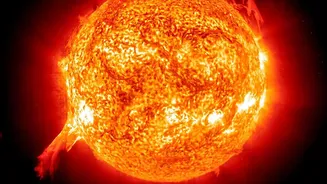
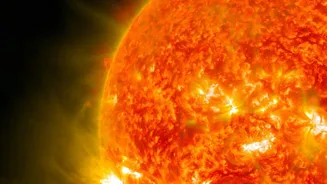
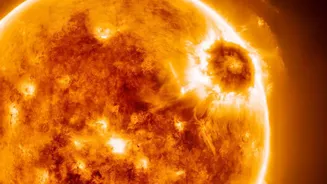
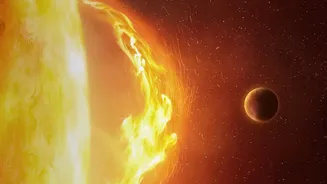
The Sun's corona is one of the most enigmatic places in our solar system. It is millions of degrees hotter than the surface of the Sun, and scientists are still working to understand why. It's also the source of Coronal Mass Ejections (CMEs), which are massive explosions of plasma and magnetic fields that rocket out into space. When a CME is aimed at Earth, it can wreak havoc on our satellites, communication networks, and power grids. Observing these eruptions right as they happen, close to the Sun, is incredibly difficult because the Sun's own light is blindingly bright. Past missions have struggled to track the faint, early evolution of these events, leaving a gap in our understanding of their power and trajectory.
A Breakthrough in Joint Observation
This is where the synergy between Aditya-L1 and Proba-3 becomes crucial. For the first time, scientists, led by a team at the Indian Institute of Astrophysics in Bengaluru, combined data from both missions observing the same CMEs. The study, published in the journal 'Astronomy & Astrophysics', focused on two distinct eruptions that occurred in September 2025. While Proba-3's ASPIICS instrument captured sharp images showing the eruption's shape and mass, Aditya-L1's VELC instrument performed spectroscopy, analysing the light to determine the temperature and density of the superheated gas. By combining these two different but complementary methods, the team was able to build a more complete and cross-checked picture of the CMEs than either mission could achieve alone.
What the New Study Reveals
The joint analysis revealed fascinating details about the two observed CMEs. One eruption was fast, travelling at about 645 kilometres per second, while the other was much slower, at 145 km/s. The data showed how the energy in these eruptions was distributed between kinetic energy (motion) and thermal energy (heat). For the faster CME, thermal energy was only about 1% of the total, but for the slower one, the thermal energy grew until it was comparable to the kinetic energy. Critically, the independent measurements of the eruption's mass and energy from both spacecraft agreed well, giving scientists high confidence in their findings. This demonstrates the powerful potential of combining imaging and spectroscopic techniques to understand how solar storms are born and how they build up energy in their initial moments.
A Milestone for India in Space
This collaboration is more than just a scientific success; it's a testament to India's growing prominence in global space science. The fact that ESA's Proba-3 mission was launched on an Indian PSLV rocket already highlighted ISRO's role as a reliable international partner. Now, with scientists at the Indian Institute of Astrophysics leading the analysis of joint data from an Indian flagship mission, it showcases the nation's end-toend capabilities, from launch to cutting edge scientific research. This successful partnership strengthens the bond between India and Europe in space exploration and sets a precedent for future collaborative projects. It proves that by combining resources and expertise, the global scientific community can tackle bigger challenges and unlock deeper mysteries of any cosmos.