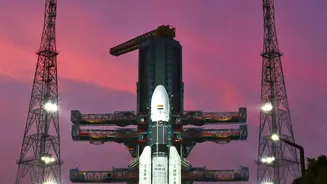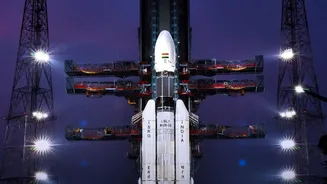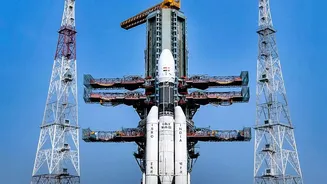



Meet Pushpak: India's Space Shuttle
Imagine if a commercial airline had to build a new aircraft for every single flight. The cost of a ticket would be astronomical. This is precisely the problem ISRO is solving with its Reusable Launch Vehicle-Technology Demonstrator (RLV-TD), affectionately
named 'Pushpak'. Unlike traditional expendable rockets that are discarded in the ocean, Pushpak is a winged vehicle designed to function like a spaceplane. After delivering its payload, it is designed to fly back to Earth and land on a conventional runway, just like an aircraft. This allows its most valuable and complex components—the engines, avionics, and airframe—to be refurbished and used for subsequent missions, heralding a new, more sustainable era of space exploration. The goal is ambitious: to drastically cut the cost of launching satellites into Low Earth Orbit.
Mastering the Critical Landing
The most challenging part of a reusable system is getting it back to Earth in one piece. ISRO recently concluded a series of three crucial Landing Experiments (LEX) at the Aeronautical Test Range in Chitradurga, Karnataka. In these tests, an Indian Air Force Chinook helicopter lifted the 6.5-metre Pushpak vehicle to an altitude of 4.5 kilometres and released it mid-air. From there, Pushpak had to find its own way to the runway, autonomously navigating and executing a perfect horizontal landing at speeds exceeding 320 km/h—faster than many fighter jets. The final test, conducted in June 2024, was performed under more severe wind conditions and from a more challenging release point, proving the vehicle's robust autonomous guidance and control systems. Critically, the same vehicle was used in the second and third tests, demonstrating the hardware's inherent reusability.
The Economics of a Game Changer
The core promise of reusability is economic. By recovering and reusing the most expensive parts of the launch system, ISRO aims to reduce the cost of placing a kilogram of payload into orbit by up to 80%, or by a factor of ten. This would dramatically lower the barrier to entry for satellite companies, research institutions, and emerging space-faring nations around the world. The global satellite launch market is a rapidly growing, multi-billion dollar industry. By offering reliable and significantly cheaper launch services, India can position itself as a dominant player, attracting a larger share of international clients who are currently launching small satellite constellations for communication, Earth observation, and navigation. This aligns with the 'Make in India' initiative, boosting the domestic aerospace industry and creating high-tech jobs.
The Road to Orbit and Beyond
While the successful landing tests are a monumental achievement, they are just the beginning. This phase focused on proving the vehicle could land autonomously from a high altitude. The next major hurdle is the Orbital Re-entry Experiment (OREX). This will involve launching a scaled-up version of Pushpak into orbit aboard a conventional rocket. After circling the Earth, it will have to re-enter the atmosphere at hypersonic speeds, endure extreme temperatures, and then perform the same autonomous runway landing. Successfully completing the OREX phase will validate the entire mission profile and pave the way for a fully operational Two-Stage-to-Orbit (TSTO) launch vehicle, where the Pushpak itself would act as the second stage, delivering satellites before returning to Earth.