





A Telescope Unlike Any Other
The Square Kilometre Array isn't one telescope, but a globe-spanning network of two. It's an intergovernmental project, decades in the making, designed to be the largest and most sensitive radio telescope ever built. One part, SKA-Low, is under construction
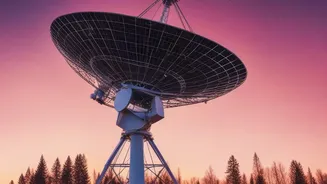
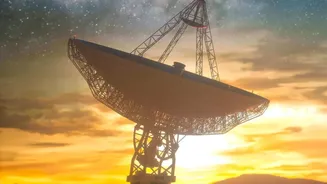
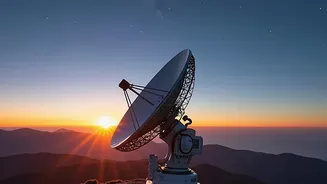
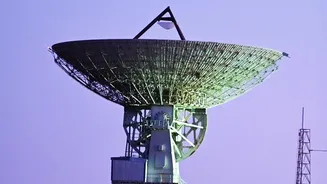
in Western Australia and will eventually consist of over 131,000 Christmas tree-shaped antennas. The other, SKA-Mid, is being built in South Africa and will feature 197 large dish antennas. These two sites were chosen for their remote locations, far from the radio interference of modern civilization, offering a clear window to the cosmos. The name comes from its ultimate ambition: to create a total collecting area of one square kilometre, giving it unparalleled sensitivity.
Tuning into the Cosmic Dawn
So, what is the SKA listening for? Its primary mission is to detect the faint, stretched-out radio signals from the very dawn of the universe. Scientists call this period the 'Cosmic Dawn,' which occurred a few hundred million years after the Big Bang when the very first stars and galaxies began to form. Before this, the universe was a dark place filled with neutral hydrogen gas. As these first stars ignited, they started to ionise the gas around them, a process known as the 'Epoch of Reionization'. The faint signal from that primordial hydrogen, stretched over billions of years by the expansion of the universe, is what the SKA-Low telescope is specifically designed to catch. Capturing this signal will give us a direct picture of how the first structures in the universe came to be.
The Power of a Global Ear
The secret to the SKA's incredible power lies in a technique called interferometry. Instead of building an impossibly large single telescope, interferometry combines the signals from thousands of smaller, widely spaced antennas. Linked by thousands of kilometres of optical fibre, the data from each antenna is collected and synchronised. A supercomputer then combines this data, making the array function as a single virtual telescope with a size equivalent to the largest distance between its antennas. The more antennas you add, the greater the collecting area, which boosts sensitivity to detect incredibly faint objects. Spreading them far apart increases the resolution, allowing the telescope to see the sky in much sharper detail than any single dish could achieve.
How it Listens So Deeply
The SKA-Low antennas in Australia are stationary, looking like a forest of metal trees. They don't physically move to point at objects. Instead, they use a digital technique called 'beamforming' to electronically 'steer' their view across the sky. Weak signals hit the antennas and are immediately amplified. The signals are then converted from electrical to optical and sent via fibre-optic cables to on-site processing facilities. For the SKA-Mid dishes in South Africa, the principle is similar, combining signals from multiple dishes to form a cohesive, high-resolution image. Both telescopes achieved a key milestone known as 'first fringes'—successfully combining the signal from two separate antennas to function as an interferometer—a crucial step proving the concept works.
Taming a Data Tsunami
Detecting these signals is only half the battle. The sheer volume of data the SKA will generate is staggering, projected to be over 700 petabytes per year, which is more than the entire world's internet traffic from just over a decade ago. This data flows from the antennas to on-site supercomputers for initial processing. From there, it's sent to a global network of SKA Regional Centres for storage and further analysis by scientists. Handling this data requires developing new technologies and algorithms, pushing the boundaries of big data processing, artificial intelligence, and machine learning. The project has been running 'Data Challenges' to prepare the global scientific community for the unprecedented scale of information that will soon be flowing.