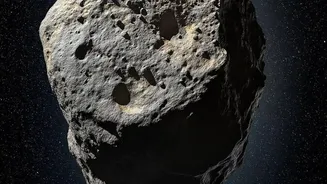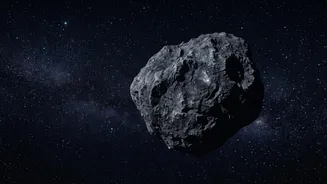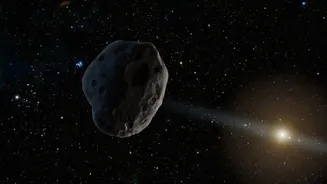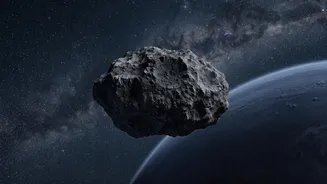







A mysterious object spotted moving through our solar system has been the subject of intense astronomical debate. Now, scientists have a definitive answer, confirming that the object, designated 2026 QQ8, is a natural space rock.
A Mysterious Visitor in the Cosmic Neighborhood
When astronomers first
detected 2026 QQ8, it was just another faint point of light moving against the backdrop of distant stars. But as they tracked its path, some unusual characteristics emerged. Its orbit and brightness were just ambiguous enough to spark a fascinating question: was this a newly discovered asteroid, or could it be a piece of human-made space junk? This initial uncertainty is becoming more common as our ability to scan the skies improves and the amount of debris from past space missions continues to grow. In some cases, spent rocket stages or defunct satellites have been mistaken for natural objects for weeks or even months.
The Challenge: Telling Rock from Rocket
Distinguishing a natural asteroid from a piece of space debris isn't always straightforward. Both can appear as small, moving dots in telescope images. However, they often behave differently. Artificial objects, like old rocket boosters, are typically hollow and have a large surface area for their mass. This means the gentle-but-constant pressure of sunlight can nudge them off course in a way that is measurable. A dense, solid rock is not so easily pushed. The community was initially split on 2026 QQ8, with its trajectory not immediately ruling out an artificial origin. Past cases have shown how convincing the disguise can be; in 2020, an object named 2020 SO was found to be a Centaur rocket booster from a 1966 NASA mission.
Unlocking Clues from Reflected Light
To solve the mystery of 2026 QQ8, astronomers turned to one of their most powerful tools: spectroscopy. This technique involves analysing the light that an object reflects. Sunlight bounces off the object’s surface, and the materials on that surface absorb some wavelengths of light while reflecting others. This creates a unique 'chemical fingerprint'. By passing the reflected light through a device called a spectrograph, scientists can see this fingerprint and determine what the object is made of. The key question for 2026 QQ8 was whether its light signature would match natural rock or materials like stainless steel and the white titanium dioxide paint used on spacecraft.
The Verdict: A Natural Wanderer
After careful observation using powerful instruments, including the Lowell Discovery Telescope in Arizona and the University of Hawaii's telescope on Mauna Kea, the data was conclusive. The spectrum of light from 2026 QQ8 was consistent with that of a rocky body, showing the tell-tale signatures of silicate minerals common in asteroids. It did not match the reflective properties of metals or paints used in spacecraft. This confirmation allowed the International Astronomical Union's Minor Planet Center, the body responsible for tracking such objects, to formally classify 2026 QQ8 as a natural asteroid.
What is 2026 QQ8 and Is It a Threat?
Now identified as a natural object, 2026 QQ8 is considered a Near-Earth Object (NEO), one of millions of rocky bodies that orbit in our solar system. Most NEOs originate in the main asteroid belt between Mars and Jupiter. While its orbit brings it into Earth's general neighborhood, detailed calculations show that 2026 QQ8 poses no threat to our planet. Its journey will continue to be tracked as part of global planetary defense efforts, which monitor the skies for any potentially hazardous asteroids. The confirmation of 2026 QQ8 serves as another successful test of the systems designed to protect Earth, demonstrating that astronomers can effectively identify and characterise objects in our cosmic vicinity.