



The Inevitable Pull of Orbital Decay
A satellite in orbit is in a perpetual state of falling, but its immense speed keeps it from hitting the ground. However, this delicate balance is easily disturbed. In low Earth orbit (LEO), typically below 400 kilometres, the atmosphere isn't completely
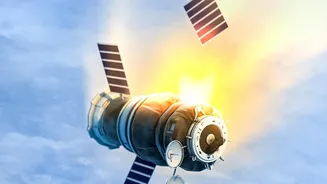
gone. There are still stray molecules of gas, and when a satellite ploughs through them at over 7 kilometres per second, it experiences drag. This atmospheric drag acts like a constant brake, slowing the satellite down. As it slows, its altitude drops, and it encounters even denser air, increasing the drag further. This process is known as orbital decay. If left uncorrected, it will eventually cause the satellite to re-enter the atmosphere and burn up, ending its mission.
The Traditional Fix and Its Limits
For decades, satellite operators have combatted orbital decay by giving their spacecraft small periodic boosts using onboard thrusters. These thrusters expel propellant to generate thrust and raise the satellite's orbit. Traditional electric propulsion systems, like Hall-effect thrusters or gridded ion engines, are incredibly efficient, often using inert gases like xenon. However, they all share a fundamental limitation: a finite fuel tank. Once the propellant runs out, the satellite's life is effectively over, no matter how healthy its other systems are. This is especially problematic for missions in very low Earth orbit (VLEO), where the higher atmospheric drag would require so much propellant that long-duration missions become impractical.
A Revolutionary Idea: Inhaling Space
Instead of fighting the atmosphere, engineers began asking: what if we could use it? This is the core concept behind Air-Breathing Electric Propulsion (ABEP), sometimes called RAM-EP. An ABEP system is designed to do something that sounds like science fiction: it collects the very atmospheric particles that cause drag and uses them as fuel. By turning a problem into a resource, these thrusters could theoretically allow a satellite to operate indefinitely without carrying its own propellant. This innovation opens the door to a new class of long-lived missions that can fly closer to Earth than ever before, offering benefits like higher-resolution imaging and lower-latency communications.
How an Air-Breathing Thruster Works
An ABEP system has two main parts: a special intake and an electric thruster. The intake is a passive, cleverly designed scoop that funnels the scarce atmospheric molecules—mostly atomic oxygen and nitrogen at these altitudes—into the thruster. Once collected, the thruster, which is powered by the satellite's solar panels, uses electric and magnetic fields to ionize these gas particles, turning them into a plasma. This plasma is then accelerated and expelled at extremely high velocity, generating thrust. This thrust is designed to precisely counteract the atmospheric drag, allowing the satellite to maintain a stable orbit. The entire process works without complex moving parts, making it reliable for long-term use.
The Promise of Sustainable Space
The implications of this technology are enormous. By eliminating the need for onboard propellant, satellites can be made smaller and lighter, reducing launch costs. More importantly, it extends mission lifetimes from a few years to potentially decades, maximizing the return on investment. This also has a significant impact on space sustainability. Satellites in VLEO naturally de-orbit faster if they fail, reducing the risk of them becoming long-term space debris. Furthermore, ABEP enables persistent observation and communication from lower altitudes, which could revolutionize everything from disaster monitoring to global internet access. Research and development, led by organizations like the European Space Agency (ESA) and private companies, is rapidly maturing the technology, with successful ground tests already completed.
Challenges on the Horizon
Despite its promise, air-breathing propulsion is not without its challenges. Designing an intake that can efficiently collect enough particles in the near-vacuum of VLEO is a major technical hurdle. The atmospheric composition, particularly corrosive atomic oxygen, can also degrade thruster components over time, limiting their lifespan. Furthermore, the thruster must be powerful and efficient enough to consistently generate enough thrust to overcome drag, which requires a significant amount of electrical power from solar arrays. Ongoing projects, such as ESA's work with TransMIT GmbH and projects funded by DARPA in the US, are focused on solving these issues, developing more robust materials and electrode-less thruster designs to ensure longevity and reliable performance.