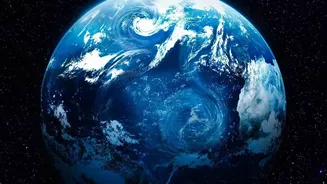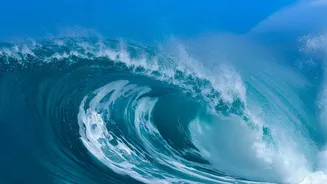




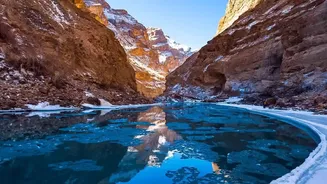

We often hear the ocean is blue because it reflects the sky. It’s a nice thought, but the real reasons are far more fascinating, involving a mix of physics, biology, and geology that 'paints' the water in a stunning array of hues.
The Real Reason for Blue
The primary reason the
ocean is blue has to do with how water absorbs sunlight. Sunlight is a mix of all the colours of the rainbow, from red to violet. When this light enters the ocean, water molecules are much better at absorbing the longer wavelengths of light—the reds, oranges, and yellows. The shorter, blue wavelengths are not absorbed as easily. Instead, they penetrate deeper, get scattered by the water molecules, and are reflected back to our eyes. This selective absorption is the fundamental reason why large, deep bodies of water appear blue. A glass of water is clear because there isn't enough of it to absorb a noticeable amount of light, but in the vastness of the ocean, this effect becomes profound.
When Algae Paints the Water Green
If all water just absorbed red light, you might expect the ocean to be the same shade of blue everywhere. But it isn't, and one of the biggest artists at work is phytoplankton. These are microscopic, plant-like organisms that form the base of the marine food web. Like plants on land, they use a green pigment called chlorophyll for photosynthesis. Chlorophyll is excellent at absorbing red and blue light to create energy, but it reflects green light. When phytoplankton are present in high concentrations, they change the ocean's colour. The more phytoplankton in the water, the more green light is reflected, shifting the ocean’s hue from blue to blue-green, or even a rich emerald. So when you see green water, you are often looking at a thriving aquatic ecosystem.
Turquoise Shallows and Sandy Bottoms
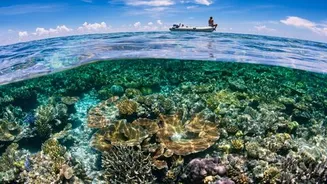
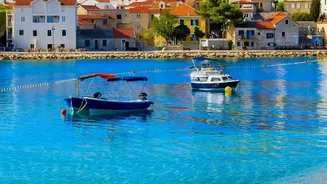
The brilliant turquoise waters famous in tropical destinations like the Caribbean are a result of a different set of factors: depth and the seafloor itself. In these shallow areas, sunlight can easily penetrate all the way to the bottom. If the bottom is made of white sand or light-coloured coral, it acts like a giant mirror, reflecting the sunlight back up through the water. Because the water is not deep enough to absorb all the longer wavelengths, a mix of blue and green light makes the return trip to your eyes, creating that iconic, vibrant turquoise. The clarity of the water is key; with few particles or phytoplankton to interfere, the light can make the round trip to the bright seabed and back.
The Murky Influence of Sediment
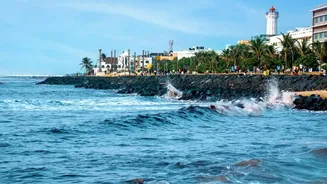
Not all ocean water is crystal clear. Near coastlines where rivers empty into the sea, or after powerful storms churn up the seabed, the water can take on a brownish or yellowish cast. This is caused by suspended particles like sand, silt, and clay, collectively known as sediment. These particles scatter sunlight in a way that doesn't favour blue. Instead, they absorb and scatter light more broadly across the spectrum, which often results in a murky, brown appearance. Decaying organic matter, washed in from forests and marshes, can also dissolve in the water, creating a tea-like, yellowish substance that strongly absorbs blue light and further shifts the colour away from blue.
The Inky Blue of the Deep Ocean
Far from land, in the open ocean where the water can be thousands of metres deep, you'll find the most intense, dark navy blue. This deep, pure blue is the true colour of water when it is largely free of sediment and life. With immense depth, there is more water to absorb almost all the longer wavelengths of light. Furthermore, there is no seabed nearby to reflect light back to the surface. The blue light penetrates deepest but is eventually absorbed as well, with virtually no sunlight reaching beyond about 200 metres. What little light is scattered back from the upper layers is almost exclusively from the blue part of the spectrum, giving the deep ocean its dark, foreboding, and beautiful colour.