

A New Window on the Universe
Named after Nancy Grace Roman, NASA's first chief of astronomy and the “mother” of the Hubble Space Telescope, the Roman Space Telescope is a next-generation observatory designed for cosmic surveys. While its primary mirror is the same size as Hubble's
at 2.4 meters, its power lies in its incredible field of view. Its Wide Field Instrument (WFI) can capture a patch of the sky at least 100 times larger than Hubble can in a single snapshot, all while maintaining similar sharpness. This allows it to map vast regions of space with breathtaking speed and efficiency, creating panoramic views of the universe that were previously impossible. Launched on a SpaceX Falcon Heavy, the telescope is now on its way to its operational orbit about 1.5 million kilometers from Earth, with its first images expected in early 2027.
Hunting the Mystery of Dark Energy
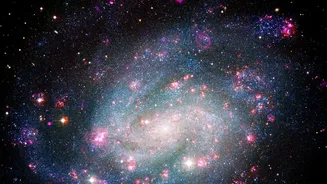
One of Roman’s primary goals is to tackle one of the biggest puzzles in physics: dark energy. This mysterious force is believed to be responsible for the accelerating expansion of the universe, but scientists still don't know what it is. Roman will investigate it in two main ways. First, it will hunt for thousands of Type Ia supernovae—exploding stars that have a predictable peak brightness. By measuring the light from these 'standard candles', astronomers can calculate their distance and, in turn, how fast the universe was expanding at different points in its history. Second, Roman will map the distribution of billions of galaxies across cosmic time. This will reveal how dark energy has influenced the large-scale structure of the universe, providing critical clues to its nature.
A Census of a Thousand New Worlds
Roman is also a revolutionary planet-hunting machine. Astronomers expect it to discover thousands of new exoplanets, potentially finding as many as 100,000 using the transit method alone, where it detects the slight dimming of a star as a planet passes in front of it. But its real game-changer is its ability to use a technique called gravitational microlensing. This occurs when a star or planet passes in front of a more distant star, and its gravity acts like a magnifying glass, briefly brightening the background star's light. This method is sensitive enough to find planets much farther from their stars and even so-called rogue planets that wander through the galaxy untethered to any star. This will give scientists a more complete census of the types of planets that exist in our Milky Way.
Wide-Angle Lens, Not a Replacement
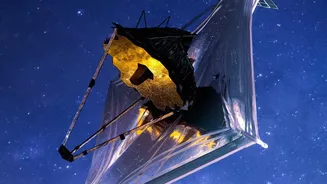
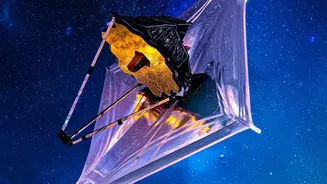
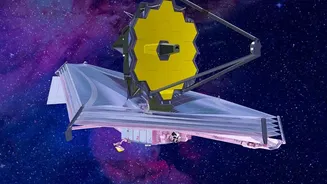
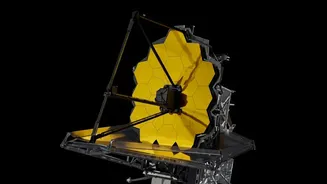
It’s natural to wonder how Roman compares to the James Webb Space Telescope (JWST), but they are designed to be partners, not rivals. Think of Roman as a wide-angle lens and Webb as a telephoto zoom. Roman will rapidly scan enormous sections of the sky, identifying tens of thousands of interesting targets—be it unusual galaxies, distant supernovae, or promising exoplanets. Webb, with its much larger mirror and deeper infrared sensitivity, can then perform detailed follow-up observations on the most compelling discoveries Roman makes. Roman provides the grand cosmic map, while Webb zooms in to study the intricate details. Together, they will offer a more complete picture of the universe, from its large-scale evolution to the specifics of faraway worlds.