






A Breakthrough in Seeing the Unseen
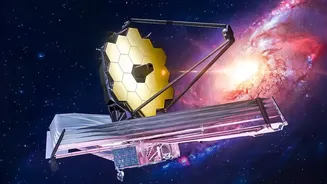
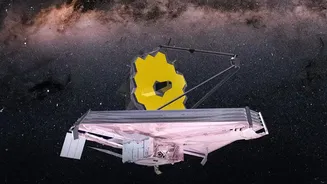
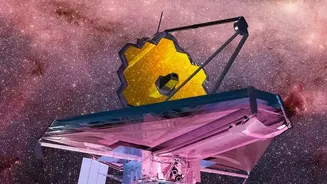
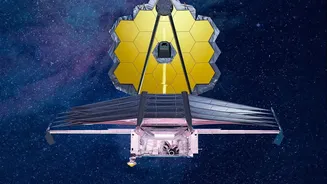
In a series of groundbreaking observations, astronomers using the James Webb Space Telescope have confirmed the presence of water vapour in the atmospheres of multiple exoplanets, including several classified as 'super-Earths'. While water has been detected
on exoplanets before by telescopes like Hubble, the JWST's incredible sensitivity provides a much clearer and more detailed picture. For example, on planets like GJ 1214 b, a 'mini-Neptune' about 40 light-years away, Webb's instruments were able to peer through thick haze that previously obscured our view, revealing an atmosphere likely rich in water vapour. These findings represent a monumental step forward, demonstrating the telescope's power to analyze the composition of worlds orbiting other stars.
What Are 'Super-Earths'?
The term 'super-Earth' might conjure images of a bigger, better version of our own planet, but it's purely a size classification. These are planets with a mass greater than Earth's but lighter than ice giants like Neptune. They are one of the most common types of planets found in our galaxy, yet intriguingly, our own solar system doesn't have one, making them a fascinating puzzle for scientists. Super-Earths come in a wide variety, from scorching hot rocky worlds orbiting perilously close to their stars to potential 'water worlds' covered in deep oceans. Their larger size could give them a stronger gravitational pull, theoretically making them better at holding onto a substantial atmosphere.
The Power of Infrared Vision
So, how does the JWST actually 'see' water hundreds of light-years away? The technique is called transit spectroscopy. When an exoplanet passes in front of its host star from our point of view, a tiny amount of starlight filters through the planet's atmosphere. Different chemical elements and molecules in the atmosphere absorb specific wavelengths, or colours, of light. Water vapour, for instance, blocks very specific shades of infrared light. The JWST's powerful infrared spectrographs, like NIRSpec and MIRI, are exquisitely tuned to detect these subtle dips in the light's spectrum, essentially revealing a chemical fingerprint of the planet's atmosphere. This allows scientists to identify molecules like water, methane, and carbon dioxide from across the galaxy.
Water Vapour Doesn't Mean Habitable... Yet
Finding water is thrilling, but it's important to manage expectations. The detection of water vapour, especially on super-hot planets, does not mean we've found a lush, Earth-like world with flowing rivers. For instance, on the exoplanet GJ 486 b, which has a surface temperature of around 430 degrees Celsius, scientists detected hints of water vapour. If this water is part of a planetary atmosphere, it would likely be a scorching steam bath, perhaps replenished by volcanic activity. In other cases, like the gas giant WASP-18 b, the temperature is so extreme it would tear most water molecules apart, making the fact that Webb can detect the remnants a testament to its sensitivity. The presence of water is a crucial first step, but it's just one ingredient in the complex recipe for habitability.
A New Era of Exploration
Each detection of an atmospheric component on a distant world is a crucial data point. These observations are not just about finding water; they are about understanding the sheer diversity of planets in the universe. By cataloging the atmospheres of hot Jupiters, rocky super-Earths, and hazy mini-Neptunes, scientists can refine their theories about how planets form and evolve. The JWST's ability to peer into these atmospheres is transforming exoplanet science from a field of discovery to one of characterization. We are moving beyond simply knowing a planet is there to learning what it's made of and what its environment might be like. This paves the way for the ultimate goal: identifying a rocky, temperate planet with an atmosphere that shows biosignatures—the chemical signs of life.