
Reading Light From Light-Years Away
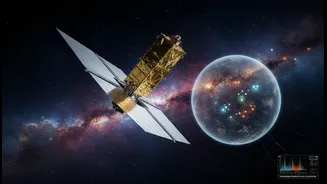
Imagine trying to figure out the ingredients of a cake by looking at it from across a football field. That’s the scale of the challenge astronomers face. Their solution is a clever technique called transmission spectroscopy. When an exoplanet passes in front
of its star from our perspective, a tiny sliver of starlight filters through the planet's atmosphere. Instruments like those on the James Webb Space Telescope (JWST) can analyze this light. Each chemical element and compound in the atmosphere absorbs light at a unique wavelength, leaving a specific fingerprint in the starlight. By reading these missing slivers of light, scientists can identify gases like methane, carbon dioxide, and, crucially, water vapor.
Why Water Is More Than Just Wet
Finding water on a distant planet is exciting, but its true value lies in what it tells us about the planet's overall chemistry. Water is a fantastic solvent and plays a central role in countless chemical reactions. Its presence, state (vapor or ice), and abundance provide a baseline for interpreting other discoveries. For instance, the detection of methane alongside water can hint at specific atmospheric or geological processes. On the exoplanet K2-18 b, a world 8.6 times more massive than Earth, scientists found both methane and carbon dioxide in its water-rich atmosphere. The relative lack of ammonia in this mix supports the tantalizing hypothesis that K2-18 b could be a 'Hycean' world—a planet with a global ocean under a hydrogen-rich atmosphere.
The Chemical Story Water Unlocks
Water doesn't just provide context; it actively shapes a planet's chemistry. The presence of significant water vapor can influence atmospheric temperature and pressure, affecting which other chemicals can exist and in what state. This is critical when hunting for 'biosignatures'—chemicals that could indicate the presence of life. On Earth, for example, a gas called dimethyl sulfide (DMS) is produced only by life, primarily marine phytoplankton. A tentative signal for DMS was also found on K2-18 b. While this detection is far from conclusive and could have non-biological origins on a planet so different from our own, it demonstrates the new level of chemical investigation that's possible. Water clues point scientists toward which other, more complex molecules they should be looking for.
Building a Portrait of a Distant World
By combining the clues from water and other molecules, astronomers can start to build a surprisingly detailed picture of an alien world. They can infer the potential for clouds, estimate atmospheric temperatures, and model the chemical reactions happening miles above the surface. This process is complex, and interpretations can be debated for years. Recent studies even suggest that some planets, known as sub-Neptunes, might have deep layers of water hidden beneath the upper atmosphere that telescopes can see. This would mean that the water vapor we detect is only a fraction of the planet's total water inventory. It's a reminder that every discovery opens up new questions and pushes scientists to refine their models.
The Next Frontier: Searching for Imbalance
Ultimately, the search for life isn't just about finding one specific molecule. It's about finding a chemical imbalance—a mix of gases that shouldn’t exist together without some active process, like life, constantly producing them. Earth's atmosphere, rich in oxygen and containing a dash of methane, is a classic example of such a disequilibrium. Water acts as the chemical stage upon which these potential life-driven dramas unfold. Understanding the role of water in an exoplanet’s atmosphere is the first step in determining if its sky is just a product of mundane chemistry or if it might be humming with the signature of life.