



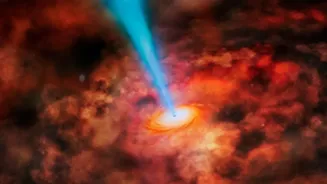
The Universe's Oldest Photograph
The 'ancient light' in question is the Cosmic Microwave Background, or CMB. Think of it as the universe's baby picture. For the first 380,000 years after the Big Bang, the universe was an incredibly hot, dense soup of particles and radiation. Light couldn't
travel far without being scattered, making the cosmos completely opaque. As the universe expanded and cooled, protons and electrons finally combined to form neutral atoms. This event, known as 'recombination', set the light free to travel across space unimpeded. That liberated light, now stretched into microwave wavelengths by cosmic expansion, is what we detect today as the CMB. It fills our entire sky, providing a snapshot of the infant universe.
A Twist in the Cosmic Tale
This ancient light has a property called polarization, which describes the orientation of the light waves. According to the Standard Model of Cosmology—our current best explanation for the universe's evolution—this polarization should stay fixed as the light journeys to us. However, recent and increasingly precise measurements from telescopes like the Planck satellite and the Atacama Cosmology Telescope have hinted that the polarization angle is being rotated by a tiny amount, roughly 0.3 degrees. This phenomenon is known as 'cosmic birefringence'. It's as if the very fabric of spacetime is acting like a crystal, twisting the light as it passes through.
Breaking a Fundamental Symmetry
So, what could cause such a rotation? The leading theory is that something in the universe is violating a fundamental principle called parity symmetry. Parity symmetry is the idea that the laws of physics should be the same for an object and its mirror image—that the universe shouldn't have a 'handedness'. While this symmetry is known to be broken by the weak nuclear force at tiny subatomic scales, it was expected to hold true on the vast scales of the cosmos. A detection of cosmic birefringence would suggest this is not the case. This would be evidence of new, undiscovered physics, likely stemming from the epoch of inflation just moments after the Big Bang.
The Hunt for Dark Clues
The most exciting implication of this cosmic twist is its potential connection to the biggest mysteries in physics: dark matter and dark energy. Together, these enigmatic components make up about 95% of the universe, yet we know almost nothing about them. The rotation could be caused by an interaction between light and a mysterious field permeating the universe. One popular candidate is a hypothetical particle called an axion, which is also a contender for dark matter. If axion-like fields exist and couple to light, they would rotate its polarization as it travels over billions of years, providing the first non-gravitational evidence of their existence.
What Happens Next?
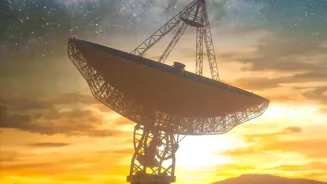
The evidence for cosmic birefringence is tantalizing but not yet definitive. The signal is incredibly faint, and scientists must meticulously rule out all other possibilities, such as interference from dust within our own Milky Way or tiny calibration errors in the telescopes themselves. Researchers are developing new analysis techniques to get a cleaner measurement. Upcoming experiments, such as the Simons Observatory in Chile, will provide even more precise data on the CMB's polarization. These next-generation telescopes will either confirm the rotation with discovery-level significance, opening a new chapter in physics, or rule it out, deepening the mystery of the dark universe.