







An Asteroid Like No Other
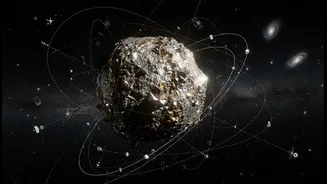
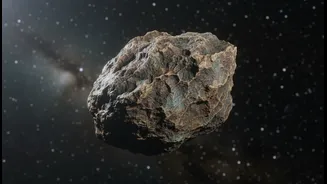
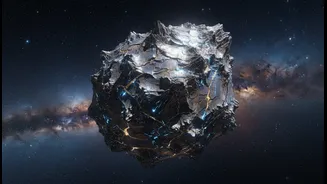
The target is 16 Psyche, a giant, potato-shaped object in the main asteroid belt. Unlike most asteroids, which are rocky or icy, Psyche appears to be extraordinarily rich in metal. Scientists believe it may be the exposed nickel-iron core of a planetesimal,
an early planetary building block whose rocky outer layers were violently stripped away by collisions billions of years ago. We can't drill to Earth's core, but visiting Psyche offers a unique chance to study the kind of material hidden deep inside our own planet. While early estimates suggested it could be up to 95% metal, more recent analysis indicates it's likely a mixture of 30% to 60% metal and rock, which is still exceptional.
The Long Journey to a Metal World
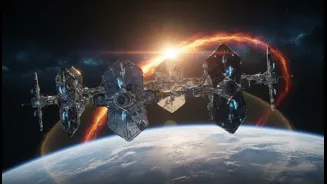
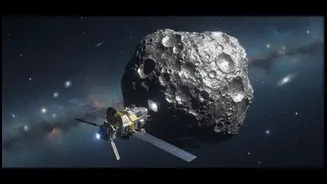
The NASA spacecraft, also named Psyche, launched in October 2023 aboard a SpaceX Falcon Heavy rocket. Its journey is a long and patient one. The van-sized probe is using highly efficient solar-electric propulsion, firing Hall-effect thrusters that use solar energy to create a gentle but constant push. This long voyage includes a key manoeuvre: a Mars gravity-assist. In May 2026, the probe flew by Mars, using the planet's gravity to gain speed and adjust its trajectory toward the asteroid belt. The spacecraft is now on course to arrive at Psyche in the summer of 2029, where it will be captured by the asteroid's gravity and begin a 21-month science mission.
A Toolkit for Uncovering Secrets
To map a world it has never seen, the Psyche probe is equipped with a sophisticated suite of scientific instruments. The Multispectral Imager, a pair of high-resolution cameras, will take pictures and use different colour filters to distinguish between metallic and rocky (silicate) areas on the surface, helping create detailed topographic maps. A Gamma-Ray and Neutron Spectrometer (GRNS) will chart the asteroid’s chemical composition. By detecting particles emitted from Psyche’s surface as it's hit by cosmic rays, the GRNS can identify specific elements like iron and nickel. Finally, a Magnetometer will search for a remnant magnetic field. If Psyche was once the molten core of a planetesimal, evidence of that ancient magnetic field could be frozen in its metal today.
Building the Map, Piece by Piece
The mapping process will be systematic. Once it arrives in 2029, the spacecraft will enter a series of four distinct science orbits, each at a different altitude. The higher orbits are for initial characterization and mapping, while the lower orbits will allow for more detailed analysis of the surface composition and gravity field. Data from all the instruments will be layered together. The imagers provide the visual and topographic base map. The GRNS will overlay this map with chemical information, showing which areas are rich in which elements. Meanwhile, tiny fluctuations in the spacecraft's orbit, tracked by its radio communications system, will reveal Psyche’s gravity field, hinting at its internal structure and mass distribution. The magnetometer's findings will add another layer, indicating whether the asteroid has a preserved magnetic field. Together, these datasets will create the first-ever comprehensive portrait of a metallic world.
Science First, Resources Second
The staggering hypothetical value of Psyche's metals—sometimes estimated in the quadrillions of dollars—has captured public imagination. However, NASA's mission is purely scientific. Its goal is to understand planet formation and explore a new type of world, not to assess mining potential. The technological and economic barriers to asteroid mining are immense, and any such venture is many decades, if not centuries, away. The value of Psyche for now is not in its resources, but in the knowledge it holds. It represents a fundamental building block of our solar system, and studying it will provide unprecedented insights into the violent, creative processes that formed Earth and the other rocky planets.