



Flexibility vs. Mobility: What’s the Difference?
Many of us use the terms flexibility and mobility interchangeably, but they represent two very different concepts. Flexibility is the ability of your muscles and soft tissues to lengthen passively. Think about lying on your back and using a strap to pull
your leg toward your chest. That’s a demonstration of your hamstring's flexibility. It's your passive range of motion—how far a joint can be moved by an external force, like gravity or your own hand. Mobility, on the other hand, is your ability to actively move a joint through its entire range of motion with strength and control. It’s about how far you can move a limb using only the power of your own muscles. If you stand and lift your leg straight out in front of you without any help, that's active mobility. The gap between what you can do with help (flexibility) and what you can do on your own (mobility) is where injuries can happen and where true functional strength is built.
The Use-It-or-Lose-It Principle
Why can you get your leg so much higher with a strap than you can by just lifting it? Because your nervous system doesn't trust that you can safely control that position. Your brain acts as a protective governor. If it senses instability or weakness in a particular range of motion, it will put on the brakes by tightening muscles to prevent injury. This is a smart survival mechanism, but it means that all the passive stretching in the world won't automatically grant you access to that range in dynamic, real-world movements. Stretching might temporarily increase your flexibility, but without teaching your nervous system how to control that new range, your body will likely revert to its old, tighter patterns. The body essentially follows a 'use it or lose it' policy for movement; if you don't actively use and strengthen a range of motion, your brain won't keep it as a viable movement option.
Bridging the Gap with Active Control
The key to making your flexibility useful is to build strength and control at the very end of your available range of motion. This process teaches your nervous system that these positions are safe and usable, effectively converting passive flexibility into active mobility. Instead of just holding a stretch, the goal is to actively engage the muscles around the joint while it is in a lengthened position. This approach not only makes your newfound flexibility more permanent but also builds resilience against injury, as you become stronger and more stable in positions where you were previously vulnerable. Think of it as earning your range of motion rather than just borrowing it. By strengthening muscles in their most lengthened state, you are building a more robust and capable body.
A Movement to Master: Controlled Articular Rotations
One of the most effective ways to build active control is through Controlled Articular Rotations, or CARs. These are slow, deliberate, and mindful movements where you actively rotate a joint through its greatest possible pain-free circle. Unlike simply swinging your arm in a circle, CARs require you to create tension throughout your body to isolate the joint you're working on. This focused effort helps improve joint health by stimulating synovial fluid, enhances your brain's connection to the joint, and serves as a daily self-assessment of your movement quality. For example, to perform a shoulder CAR, you would stand with your core tight and slowly move your arm through its full range of flexion, abduction, extension, and rotation, trying to 'draw' the biggest circle possible without your torso moving. This trains your brain to control the outer limits of your shoulder's mobility, making that range both accessible and safe.
Integrating Usable Mobility Into Your Life
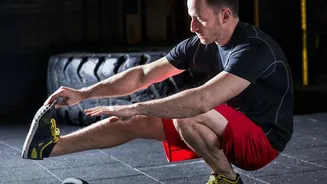
The goal isn't to spend hours on mobility work; it's to integrate smart, active movements into your existing routine. You can perform a few minutes of CARs for your hips, shoulders, and spine each morning as a way to check in with your body and lubricate your joints. These can also serve as an excellent warm-up before a workout, preparing your joints for the demands to come. Similarly, you can add active mobility drills after your workout. For instance, after squatting, you could perform controlled leg lifts from a deep squat position to build strength at the end range of your hip flexion. The mindset shift is from 'How flexible am I?' to 'How well can I control my movement?'. By focusing on building strength within your flexibility, you'll unlock a new level of performance, resilience, and confidence in your body's capabilities.