







A Museum With No Walls
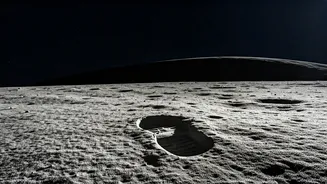
Between 1969 and 1972, twelve American astronauts walked on the Moon. In doing so, they left behind more than just flags and scientific equipment. They left their tracks. The bootprints of Neil Armstrong, Buzz Aldrin, and the other Apollo explorers are
still there today, looking almost as fresh as the day they were made. The entire lunar surface is effectively a pristine, open-air museum preserving the history of our visits. When Gene Cernan, the last man to walk on the Moon, lifted his foot from the dust in 1972, he left a print that became part of a collection of human artifacts scattered across six different landing sites—a collection that will likely outlast every structure on Earth.
The Science of Silence
So, why do these footprints last so long? The answer lies in what the Moon *doesn't* have. Here on Earth, erosion is a constant, powerful force. Wind scours away surfaces, water washes away sand and soil, and oxygen causes materials to rust and decay. Our planet is geologically and atmospherically active. The Moon, in stark contrast, is a world of near-total stillness. It has virtually no atmosphere—it’s a vacuum. That means there is no wind to blow the dust around, no rain to wash the prints away, and no weather of any kind. The fine-grained lunar soil, or regolith, is made of sharp, tiny particles that hold their shape exceptionally well, almost like wet sand, when compacted by an astronaut’s boot. Without the forces of erosion that we take for granted, anything left on the surface stays put.
Not Entirely Forever
While the headline-grabbing claim is that they will last for “millions of years,” the word “perfectly” needs a slight asterisk. The footprints are not entirely immune to change. The Moon is constantly being bombarded by a slow, steady rain of micrometeorites—tiny particles of rock and dust hurtling through space. This process, often called “gardening,” is the Moon’s primary form of erosion. Over vast timescales, these tiny impacts churn the top layer of the lunar soil. It’s an incredibly slow process, like a cosmic sandblaster working at a geological pace. Scientists estimate that the regolith is overturned at a rate of about 1 to 2 millimeters every million years. This means that while the prints will be recognizable for an immense period, they will eventually, over millions of years, be softened, blurred, and ultimately erased by this relentless cosmic dust storm.
Evidence from Orbit
We don't just have to take scientists' word for it. We have photographic proof. Since 2009, NASA's Lunar Reconnaissance Orbiter (LRO) has been circling the Moon, capturing incredibly high-resolution images of its surface. The LRO has successfully photographed all six Apollo landing sites. In these remarkable images, you can clearly see the dark, disturbed paths where the astronauts walked, the tracks left by the lunar rover, and even the faint outlines of the bootprints themselves. These photos provide stunning confirmation that the artifacts of the Apollo era remain exactly where they were left, undisturbed after more than half a century. They are a powerful visual reminder of a time when humanity reached for another world and left its mark.
A Legacy Written in Dust
Ultimately, the longevity of these footprints is more than just a cool scientific fact. It's a profound statement about our place in the universe. On Earth, our monuments crumble and our civilizations fade into dust. But on the silent, airless Moon, the simple evidence of our presence is preserved on a timescale that is difficult for the human mind to grasp. These footprints are accidental monuments. They tell a story of exploration, ambition, and the moment our species first stepped onto another celestial body. They will remain long after we are gone, a faint but persistent message in the dust, waiting for future explorers—human or otherwise—to find and wonder at who we were.