


A Universe of Data
Modern space science is a victim of its own success. Telescopes like the James Webb and the Transiting Exoplanet Survey Satellite (TESS) stream down petabytes of information, while rovers on Mars map terrain in stunning detail. For decades, human scientists
have manually sifted through this data, a painstaking process that can take years. NASA has collected over 150 petabytes of data from its missions, an archive so immense that analyzing it with traditional methods is nearly impossible. This data deluge, from identifying faint dips in starlight that might be a distant planet to analyzing the chemical composition of a Martian rock, presents a fundamental challenge. How can scientists possibly keep up with the torrent of information their own instruments are creating?
AI as the Cosmic Data Sifter
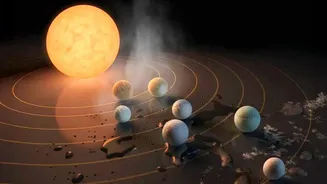
This is where artificial intelligence comes in. AI, and specifically machine learning, excels at recognizing patterns in massive datasets. NASA is now deploying AI models as powerful partners for its scientists. For example, a deep learning system called ExoMiner analyzed data from the Kepler Space Telescope and identified 301 new exoplanets that had previously been missed. More recent AI tools like RAVEN are being applied to data from the TESS mission, discovering over 100 new planets, some in unusual orbits that challenge existing theories. These AI systems aren't just faster; they learn to distinguish real planetary signals from false positives like binary stars, a task that has traditionally been a major bottleneck in exoplanet research. By automating this intensive review process, AI is radically accelerating the pace of discovery.
Smarter, Faster Exploration on Mars
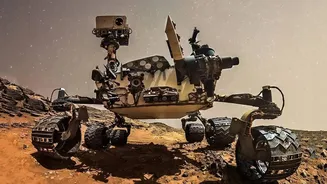
AI's impact extends far beyond data analysis on Earth. On the surface of Mars, it is giving rovers unprecedented autonomy. The Perseverance rover, for instance, relies heavily on AI for its navigation. An impressive 88% of its driving has been autonomous, using its cameras to see the terrain, identify hazards like rocks and craters, and plot a safe course without waiting for commands from Earth. This is crucial, as the time delay for signals between Earth and Mars makes real-time human control impossible. Earlier rovers like Curiosity also use AI, employing a system called AEGIS to autonomously select rock targets for its chemical-analyzing laser. This ability for robotic explorers to make their own decisions not only speeds up missions but also allows them to venture into territory that humans have never even seen.
Predicting Danger from the Sun
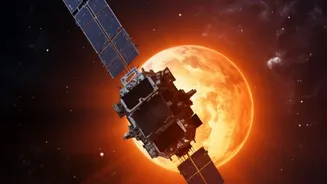
One of the most practical and vital applications of AI is in space weather forecasting. Solar flares, massive eruptions from the Sun, can hurl dangerous radiation and charged particles toward Earth, threatening satellites, power grids, and astronauts. In partnership with IBM, NASA has developed an AI model named Surya. Trained on nine years of data from the Solar Dynamics Observatory, Surya analyzes high-resolution solar images to detect patterns that precede a flare. Early tests show it can predict these events with greater accuracy and provide warnings up to two hours in advance, a significant improvement over previous methods. This gives operators crucial time to protect vulnerable infrastructure both in orbit and on the ground.
A New Partnership in Discovery
NASA's embrace of AI is not about replacing human scientists but augmenting their abilities. The agency has established formal strategies and partnerships to integrate AI more deeply into its missions. AI models are being trained to help with everything from mission planning and scheduling to monitoring the health of spacecraft. The goal is to create a seamless partnership where AI handles the heavy lifting of data processing and autonomous operations, freeing up human experts to focus on interpretation, creativity, and the big-picture questions. This collaborative approach allows scientists to do more science, more efficiently. By making its AI tools open source, NASA is also fostering global collaboration, allowing researchers everywhere to help push the boundaries of knowledge.