



Meet the Dark Universe Hunter
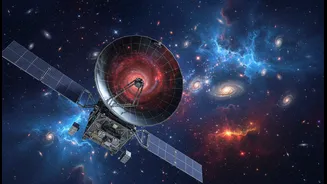
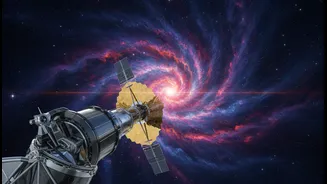
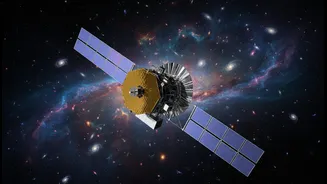
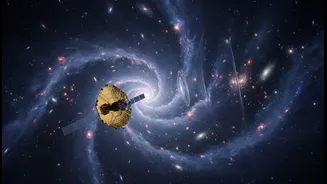
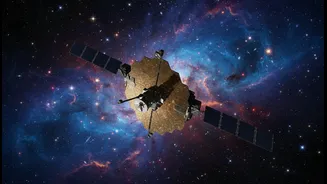
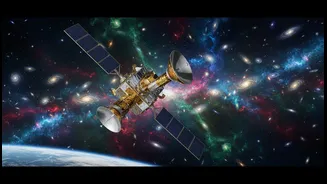
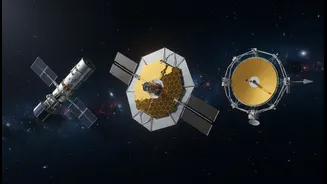
Launched in July 2023, the Euclid space telescope has a monumental task: to create the largest, most accurate 3D map of the universe ever made. Nicknamed the "Dark Universe Hunter," its primary mission is to investigate two of the biggest puzzles in modern
physics: dark matter and dark energy. These invisible components are believed to make up about 95% of the cosmos, yet we know almost nothing about them. To hunt for these dark mysteries, Euclid isn't looking for darkness; it's looking for light. By charting the positions and shapes of billions of galaxies across 10 billion years of cosmic history, scientists hope to see the subtle effects of dark matter's gravity and measure the accelerating expansion driven by dark energy.
Cosmic Lighthouses in the Dark
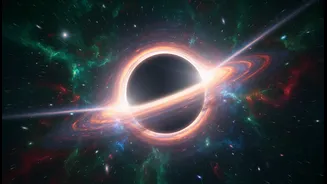
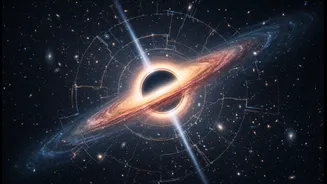
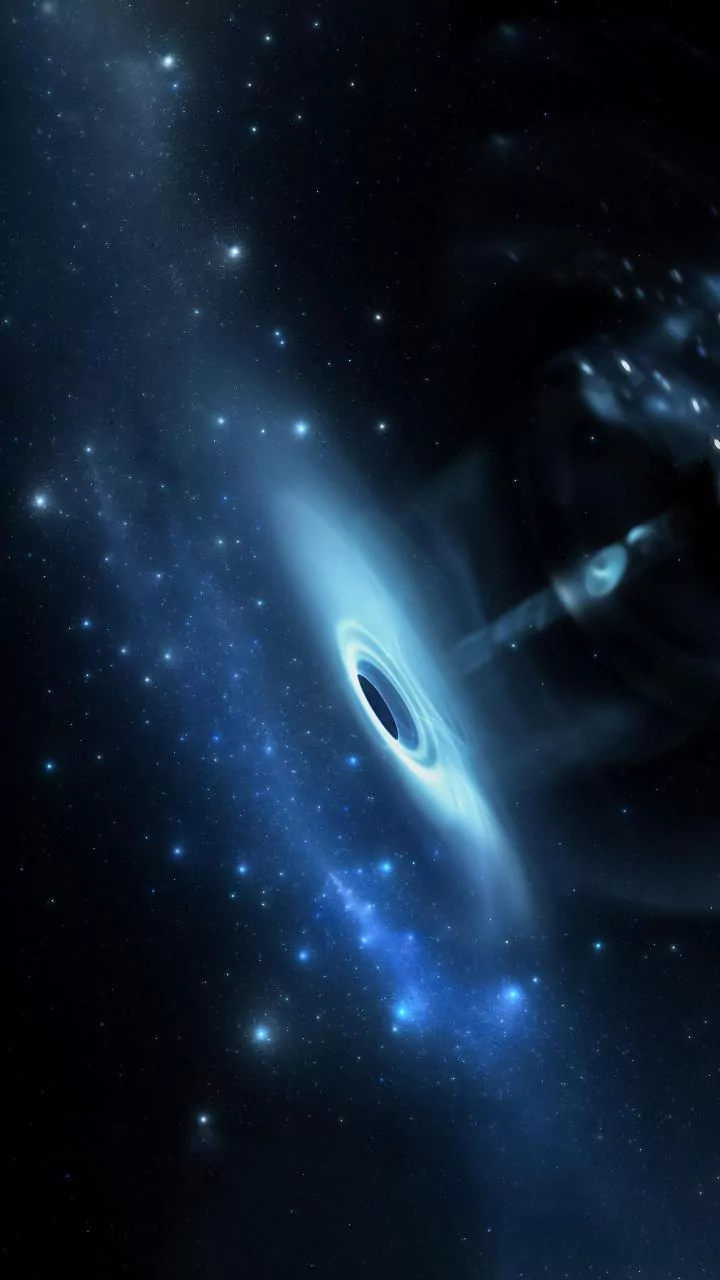
To map the vast emptiness of space, you need beacons. For Euclid, those beacons are quasars, an abbreviation for "quasi-stellar objects." These are not stars, but the intensely bright cores of distant galaxies. At the heart of a quasar is a supermassive black hole, billions of times the mass of our sun, voraciously feeding on a surrounding disk of gas and dust. The friction and immense gravity heat this material to millions of degrees, causing it to shine with the light of a trillion suns, often outshining all the stars in its host galaxy combined. This incredible brightness makes them visible even when they are billions of light-years away, acting as lighthouses that allow us to study the universe's dawn.
A Game-Changing Discovery
In a stunning early success, Euclid has identified 31 of the most ancient quasars ever found. This discovery has more than doubled the number of such objects known to science from this early cosmic era. Among them are the two oldest quasars ever observed, whose light comes from a time when the universe was just 670 million years old—only 5% of its current age. Before Euclid, finding these ancient objects was a painstaking process that took years. Euclid's wide field of view, which can capture an area 270 times larger than the Hubble Space Telescope in a single pointing, has transformed the search. It allows astronomers to survey huge patches of the sky efficiently, finding not just the exceptionally bright outliers but also the fainter, more typical quasars from that time.
A Perplexing Cosmic Mystery
These discoveries are adding to what scientists call a "perplexing" puzzle. The existence of such massive black holes so early in the universe's history challenges current theories of cosmic evolution. How did they grow so big, so fast? Finding more of these objects, especially the more 'ordinary' ones that Euclid is now able to detect, gives scientists a much larger and more representative sample to study. By analyzing the light from these quasars, which passes through gas clouds and the invisible halos of dark matter on its long journey to us, researchers can trace how the universe evolved. They can study the period known as the 'epoch of reionization', when the first stars and galaxies lit up the cosmos and brought an end to the cosmic 'dark ages'.