


Beyond the Gas Giants
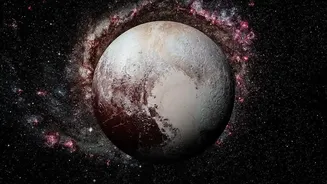
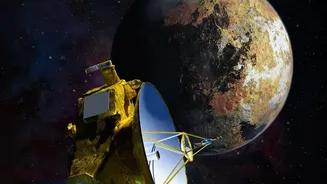
Far beyond the orbit of Neptune lies the Kuiper Belt, a vast, disc-shaped region of icy bodies that are remnants from the birth of our solar system some 4.6 billion years ago. This is the home of Pluto and thousands of other 'trans-Neptunian objects'.
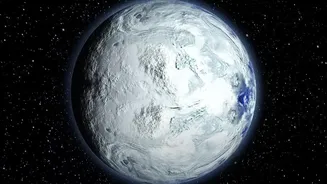
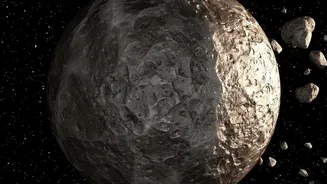
Among the most prominent are Eris and Makemake, the second and fourth-largest dwarf planets known, respectively. For decades, scientists largely considered these worlds to be inert relics—small, frigid, and geologically dead. Their immense distance from the Sun means their surfaces are fantastically cold, coated in frozen methane and other ices. Without a significant external heat source, the assumption was that any internal warmth from their formation would have dissipated billions of years ago, leaving them as solid, inactive balls of rock and ice.
A Surprising Glimpse from Webb
That long-held assumption is now being challenged by NASA's James Webb Space Telescope (JWST). Using its powerful infrared instruments, astronomers have been able to analyze the surface composition of Eris and Makemake in unprecedented detail. They confirmed the presence of methane ice, but the telescope’s precision allowed them to go a step further and measure the specific isotopes of hydrogen and carbon within that methane. The results were startling. The chemical signature of the methane did not match what would be expected from primordial material left over from the solar system's formation. Instead, the evidence points to the methane being created much more recently through geochemical processes deep inside these worlds. It suggests the methane was 'cooked' under heat and pressure, in the presence of water, within the planets' rocky cores.
Warm Cores and Icy Volcanoes
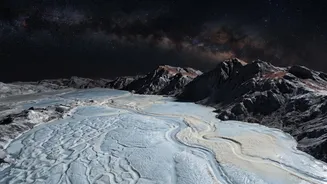
This discovery implies that Eris and Makemake are not entirely frozen solid. They likely have differentiated interiors, with a rocky core surrounded by an icy shell. The heat required to produce this 'new' methane most likely comes from the decay of radioactive elements within those rocky cores. This internal warmth could be significant enough to sustain geological activity, a process known as cryovolcanism, where slushy, semi-liquid water and other volatile compounds erupt onto the surface instead of molten rock. The presence of such activity could explain why Eris is one of the most reflective objects in the solar system; its surface may be continually repaved with fresh ice from these geysers. It strongly indicates that these dwarf planets have—or recently had—warm, active interiors and possibly even vast oceans of liquid water hidden beneath their frozen crusts.
Redefining a Habitable World
The implications of this go far beyond just two dwarf planets. It transforms our understanding of how planetary bodies evolve and where the conditions for life might exist. For a long time, the search for habitable worlds focused on the 'Goldilocks Zone'—the region around a star where temperatures are just right for liquid water to exist on a planet's surface. The discovery of active interiors in worlds like Eris, Makemake, and even Pluto, along with moons like Europa and Enceladus, shows that internal heating can create liquid water oceans far from a star's warmth. These small, icy bodies are no longer seen as just frozen relics but as a new class of potentially habitable worlds. While life as we know it hasn't been found, the presence of liquid water, organic molecules, and a chemical energy source checks off three critical boxes, forcing us to reconsider how many places in our own solar system might have had the right ingredients for life to begin.