




Getting Above the Twinkle
The same atmospheric turbulence that makes stars appear to twinkle is a major headache for astronomers. This twinkling, or scintillation, is caused by moving pockets of air at different temperatures and densities that bend and distort the light traveling
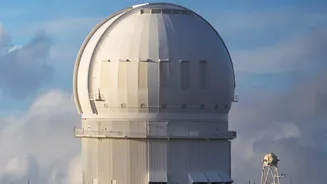
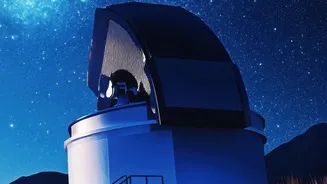
from distant objects. The result is a blurry, smeared image. By placing observatories at high altitudes, like the 13,796-foot summit of Mauna Kea in Hawaii, telescopes sit above a significant portion of this turbulent air. With less atmosphere for light to travel through, the distortion is dramatically reduced, leading to sharper, more stable images—a condition astronomers call 'good seeing'.
Seeking a Drier, Darker Sky
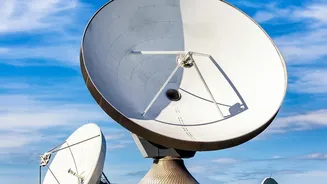
Our atmosphere is also full of water vapor, which is a problem for astronomers because it absorbs infrared and submillimeter wavelengths of light. These wavelengths are crucial for studying cool objects in the universe, including the faint, rocky asteroids that may cross Earth's path, and the dusty clouds where new stars and planets are born. High-altitude sites, such as those in Chile's Atacama Desert, are some of the driest places on Earth. Being above the moist maritime air layers allows telescopes like the Atacama Large Millimeter/submillimeter Array (ALMA) to capture this otherwise blocked radiation. Furthermore, the remote nature of these mountain peaks provides an escape from the ever-growing problem of light pollution from cities, which can wash out the faint light from distant galaxies.
The Hunt for Faint Asteroids
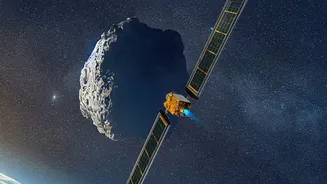
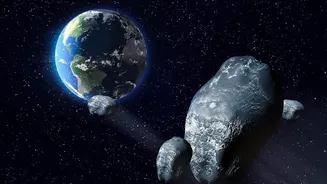
Combining these advantages makes high-altitude observatories essential tools for planetary defense. Tracking potentially hazardous asteroids requires spotting small, dark objects that reflect very little sunlight. The clear, stable, and dark skies of a mountaintop location allow telescopes to detect these incredibly faint signals that would be completely lost at sea level. By minimizing atmospheric distortion and light pollution, observatories can conduct the precise monitoring needed to calculate the orbits of near-Earth objects and assess any potential threat to our planet. While space-based telescopes are also vital, powerful ground-based observatories in prime locations remain a critical part of the global effort to catalog our cosmic neighborhood.
Catching Cosmic Ray Showers
Beyond light, the universe bombards us with high-energy particles called cosmic rays. When these particles—mostly protons and atomic nuclei—slam into Earth's upper atmosphere, they create a cascade of secondary particles known as an extensive air shower. While the original cosmic ray doesn't reach the ground, this shower of particles does. High-altitude observatories are perfectly positioned to detect these events. Some, like the Pierre Auger Observatory in Argentina, use large arrays of detectors spread over thousands of square kilometers to capture the particles from these showers. Others use specialized telescopes to detect the faint ultraviolet flash, called Cherenkov radiation, that these particle showers produce as they travel through the atmosphere faster than the speed of light in air. Being at a high elevation places these detectors closer to where the air showers develop, allowing for more sensitive and accurate measurements of these energetic cosmic messengers.
Pioneering Peaks of Discovery
From the collection of world-class telescopes on Mauna Kea to the array of radio dishes in the Atacama Desert, these high-altitude sites are humanity's premier windows to the cosmos. They sit above the clouds, moisture, and atmospheric blur, providing a pristine view that allows scientists to study everything from the formation of distant galaxies to the origins of the most energetic particles in the universe. By climbing mountains, astronomers aren't trying to get closer to the stars in distance, but to get a clearer, more unobstructed connection to the light and particles they send our way.