





Two Kinds of 'Day'
Before we dive into the strangeness, it's crucial to understand that astronomers have two ways of defining a 'day' on a planet. The first is a 'sidereal day,' which is the time it takes for a planet to complete one full 360-degree rotation on its axis.
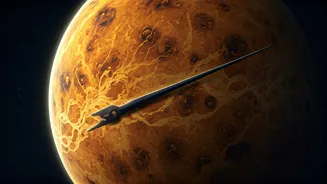
For Mercury, this takes approximately 59 Earth days, which is where the headline's figure comes from. If you were standing on Mercury and watching the distant stars, you’d see them return to the same spot in the sky every 59 Earth days. But for someone on the surface, what really matters is the 'solar day' — the time from one sunrise to the next. This is the period we associate with our 24-hour day on Earth. And on Mercury, the solar day is where things get truly bizarre. Due to a unique cosmic dance with the Sun, a solar day on Mercury lasts for a staggering 176 Earth days.
The 3:2 Spin-Orbit Dance
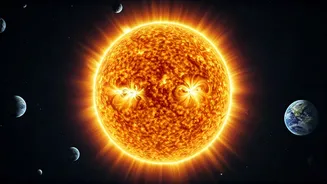
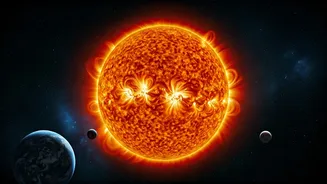
So, why is there such a massive difference? It's all because of Mercury's relationship with the Sun. The planet is tidally influenced by the Sun's immense gravity, but not completely locked like our Moon is to Earth (where one side always faces us). Instead, Mercury is in what's called a 3:2 spin-orbit resonance.
This means that for every two orbits Mercury completes around the Sun, it rotates on its axis exactly three times. Think of it like a complex planetary waltz. A Mercurian 'year' — one full trip around the Sun — takes about 88 Earth days. So, in the 176 Earth days it takes for the Sun to complete one cycle in the Mercurian sky, the planet has already orbited the Sun twice. This leads to the most counter-intuitive fact about Mercury: a single day is longer than two of its years.
A Sun That Moves Backwards
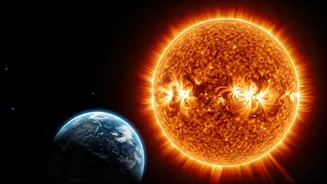
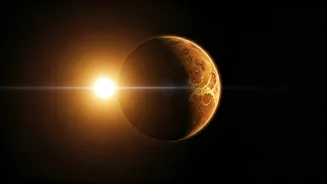
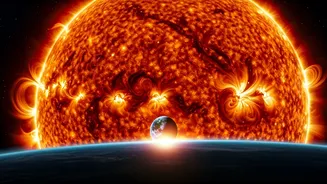
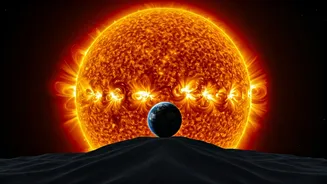
The experience of watching a sunrise on Mercury would be unlike anything on Earth. Because the planet is moving so fast in its orbit when it's closest to the Sun — at a speed that momentarily outpaces its rotation relative to the Sun — an observer would witness something extraordinary. The Sun would rise, appear to stop in the sky, move backwards for a short period, stop again, and then resume its slow journey toward the horizon.
This 'retrograde motion' of the Sun is a direct consequence of Mercury’s highly elliptical (oval-shaped) orbit and its unique spin. It’s not an illusion; from certain points on the planet’s surface, the Sun really does appear to reverse course. This adds another layer of strangeness to the already long and scorching Mercurian day, where surface temperatures on the sunlit side can reach a blistering 430 degrees Celsius.
Why This Extreme World Matters
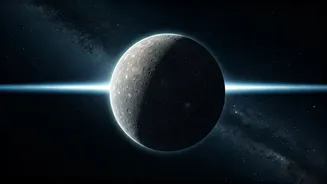
Mercury is a planet of extremes. Its days are long enough to span multiple years, its temperatures swing wildly from scorching hot to freezing cold, and its sky features a Sun that can’t seem to make up its mind. Studying these conditions is not just a cosmic curiosity. It helps scientists understand the boundaries of planet formation and the powerful effects of gravity in a solar system. By examining how planets like Mercury behave under such intense solar influence, we gain a deeper appreciation for the delicate balance that makes our own planet's stable, life-friendly environment possible.
These extreme celestial mechanics also inform the design of space missions. Probes sent to Mercury, like NASA's MESSENGER and the European-Japanese BepiColombo, must be engineered to withstand both the intense heat of the long day and the deep cold of the long night, all while navigating its complex gravitational environment.