



A Whirlpool on the Sun
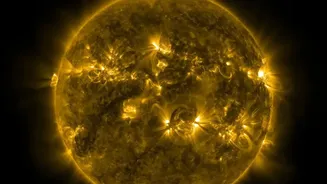
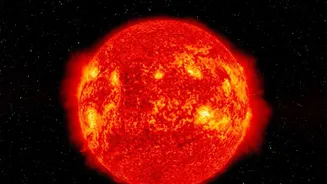
Scientists have captured the most detailed images ever of the Sun's surface, revealing tiny, swirling whirlpools of plasma that were previously only theoretical. Using the powerful Daniel K. Inouye Solar Telescope in Hawaii, researchers from institutions
including the U.S. National Science Foundation and Germany's Max Planck Institute have observed these vortices at the edges of solar granules—bubbling structures of hot gas on the Sun's surface. These newly seen phenomena are being identified as a classic physics effect known as the Kelvin-Helmholtz instability, which occurs when two fluids flow past each other at different speeds, creating a swirling or wave-like pattern. We see this effect everywhere, from waves on the ocean to the majestic clouds of Jupiter, but this is the first time it's been directly observed on the Sun's visible surface, the photosphere.
Solving Solar Mysteries
This discovery isn't just about spotting something new; it could be the key to solving longstanding puzzles about our star. One of the greatest mysteries is the coronal heating problem: why the Sun's outer atmosphere, the corona, is millions of degrees hotter than its surface. These tiny plasma vortices may act as motors, constantly twisting the Sun's magnetic field lines like a coiled spring. This process stores enormous amounts of energy, which could then be released, contributing to the extreme heating of the corona. These instabilities could also be the mechanism that fuels everything from tiny nanoflares to massive solar eruptions and coronal mass ejections (CMEs) that can have a significant impact on Earth.
Impact on Space Weather
Understanding the fundamental physics of the Sun is crucial for predicting space weather. Explosive events on the Sun can send streams of charged particles hurtling toward Earth, capable of disrupting satellites, GPS navigation, and even power grids on the ground. By understanding the root causes of this activity—such as the twisting energy generated by these newly seen plasma vortices—scientists can build better models to forecast these potentially damaging events. This discovery provides a new perspective on how magnetic energy builds up and is transported through the solar atmosphere, a critical piece of the space weather puzzle.
India's Eye on the Sun
This global scientific endeavor has a strong connection to India's own ambitions in solar research. ISRO's Aditya-L1, the nation's first dedicated solar observatory, is currently positioned at the L1 point between the Earth and the Sun, providing an uninterrupted view of our star. Aditya-L1's suite of instruments is designed to study the solar atmosphere, solar winds, and the drivers of space weather. While international telescopes like the one in Hawaii provide incredibly high-resolution images of the Sun's surface, Aditya-L1 offers a unique perspective, observing the origins of solar flares and CMEs in wavelengths that other observatories can't. The data from both ground-based and space-based observatories, including Indian contributions, will be crucial in piecing together a complete picture of the Sun's complex behavior.