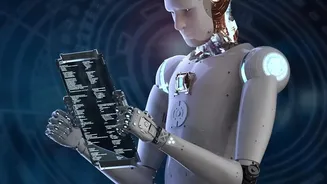




Viral videos show humanoid robots walking, running, and even folding laundry. But away from the hype, a tougher reality is setting in as companies must now answer a critical question: Can these machines deliver real economic value in the real world?
From Sci-Fi Promise to Factory Floor Pilots
The
dream of a humanoid helper is no longer just science fiction. Companies like Figure AI, Tesla, and Apptronik have developed sophisticated robots that can perform tasks in environments built for humans. We're now seeing the first wave of these machines leave the lab and enter real-world pilot programs. Figure's robots have been tested on an active production line at a BMW manufacturing plant in South Carolina, while Apptronik's Apollo robot is being trialled by Mercedes-Benz. These early deployments are focused on industrial jobs that are often repetitive, physically demanding, and ergonomically challenging for human workers, such as loading parts onto an assembly line. But as these tests conclude, the industry is shifting its focus from 'Can we build it?' to 'Is it worth the cost?'.
The Billion-Dollar Question of ROI
The single biggest hurdle for widespread adoption is the business case. Currently, a single humanoid robot can cost anywhere from $50,000 to over $200,000, with additional fees for deployment, software, and maintenance. For a business, the calculation is stark: does the robot's output justify its cost compared to a human worker? A median manufacturing worker in the US has a fully loaded annual cost of around $93,000. While a robot that can work around the clock theoretically offers significant savings, the current reality is more complex. Most humanoid robots today can only operate for two to four hours on a single battery charge, requiring significant downtime or complex battery-swapping systems to cover multiple shifts. Until costs come down and operational uptime goes up, the return on investment remains a major question mark for most businesses.
It's Not Just About Hardware
A walking, lifting robot is only as useful as its 'brain'. The second major challenge is the software and AI required for a robot to function autonomously and adapt to unpredictable real-world environments. A factory floor is not a controlled lab; tools get moved, lighting changes, and unexpected obstacles appear. While today's AI allows robots to perform trained tasks with high success, generalizing that ability to novel situations remains a significant software problem. Furthermore, integrating these advanced systems with a company's existing legacy software for managing factory operations is another layer of complexity. Many companies are discovering that the hardware is only one part of a very expensive and complicated puzzle.
Safety, Trust, and the Human Factor
Finally, there is the critical issue of safety. Unlike traditional industrial robots that are often kept in cages, humanoids are designed to work alongside people. This proximity creates new risks, and formal safety standards for collaborative, mobile humanoid robots are still being developed. A robot that weighs over 50 kilograms and moves dynamically presents a potential hazard if it falls or malfunctions. Ensuring these machines can operate safely and reliably for thousands of hours without human intervention is a non-negotiable requirement for commercial rollout. Beyond physical safety, there's also the challenge of building trust with a human workforce and effectively integrating these new 'recruits' into existing teams.
Early Results and a Glimmer of Hope
Despite the challenges, early deployments offer valuable insights. The Figure 02 robot's 11ndployment at BMW saw it handle over 90,000 parts and contribute to the production of more than 30,000 vehicles. While analysts noted that the robot's performance was slower than a human worker's and it operated on a standard shift rather than around the clock, the test provided invaluable data on hardware reliability and realworld operational hurdles. For instance, the robot's forearm was identified as a top failure point, leading to design improvements in the next generation, Figure 03. These pilot programs, though not yet demonstrating clear economic superiority, are a crucial step in bridging the gap between today's technology and a commercially viable product.