


Reading Light from Afar
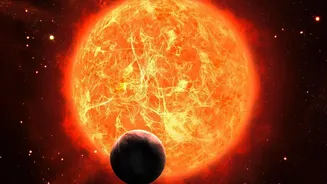
The primary method for studying exoplanets, which are planets outside our solar system, is called transit spectroscopy. Scientists wait for a planet to pass in front of its host star, an event known as a 'transit'. As the starlight filters through the planet's
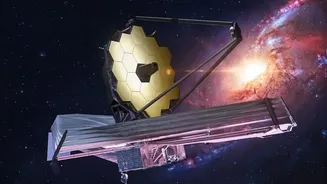
atmosphere, some of it is absorbed by the gases present. Back on Earth, powerful instruments like those on the James Webb Space Telescope (JWST) can analyze this light, spreading it out into a spectrum, which is like a rainbow with barcodes. These 'barcodes' are absorption lines that act as chemical fingerprints, revealing which molecules make up the planet's atmosphere.
Hunting for Biosignatures
Scientists aren't just looking for any chemicals; they're hunting for 'biosignatures'. A biosignature is a substance, feature, or pattern that provides evidence of life. The most sought-after biosignatures are gases that are strongly associated with biological processes on Earth. These include oxygen, a byproduct of photosynthesis, and its photochemical derivative, ozone. Methane is another key target; on Earth, much of it is produced by living organisms. The goal is to find a specific mix of gases that is hard to explain through geology alone. For instance, finding both oxygen and methane in large quantities is compelling because these gases tend to destroy each other, so their continued presence suggests something is constantly replenishing them—and that 'something' could be life.
The Context is Everything
Detecting a promising gas is only the first step. The critical and much harder part is ruling out non-biological explanations, known as 'false positives'. For example, oxygen can be produced abiotically when intense starlight splits water molecules, and methane can be released by volcanoes. Therefore, scientists must consider the entire planetary context. Is the planet in the 'habitable zone', where liquid water could exist on the surface?. What kind of star does it orbit?. The chemical balance of the entire atmosphere must be modelled to see if the combination of gases is truly unusual, or in 'disequilibrium', a state that life is known to create.
Beyond Obvious Gases
The search is also expanding to include more than just the most common gases. Scientists are considering a wider range of potential biosignatures, including molecules like nitrous oxide and dimethyl sulfide. On Earth, dimethyl sulfide is almost exclusively produced by marine life, and its potential detection on the exoplanet K2-18 b has generated significant excitement. Researchers are also exploring 'temporal biosignatures', which are seasonal changes in atmospheric gases, similar to how Earth's carbon dioxide levels fluctuate with the seasons due to plant life 'breathing'. Another frontier is the search for 'technosignatures'—signs of industrial pollution or other byproducts of a technological civilization.
A Science of Patience
The hunt for extraterrestrial life is a meticulous and challenging process. Data from telescopes can be complex, and even with the power of JWST, detecting the faint signals from the atmospheres of small, rocky planets is incredibly difficult. Scientists are keenly aware of the risk of 'false negatives'—cases where life exists, but our methods fail to detect it because the signs are too faint, have faded over time, or are simply not what we expect to find. There will be no single 'Eureka!' moment. Instead, a confirmation of life will likely come from a slow accumulation of evidence from multiple observations and different telescopes, all pointing to the conclusion that biology is the best explanation for what is being observed.