



The Daily Grind’s Hidden Cost
Think about the sheer number of coffee shops in any major Indian city, from bustling metros like Mumbai and Bengaluru to smaller towns. Each one discards kilograms of spent coffee grounds every single day. When you add home coffee makers to the mix, the scale
of this organic waste becomes staggering. Traditionally, these grounds are bagged up and sent to landfills. While they seem harmless, organic materials decomposing in landfills release methane, a greenhouse gas far more potent than carbon dioxide. This waste stream represents a missed opportunity—a nutrient-rich resource being treated as trash. Less than 1% of the coffee bean's biomass actually makes it into your cup, meaning 99% of its value is typically thrown away. This is where an unlikely hero enters the picture: the humble mushroom.
A Fungus for a Sustainable Future
Mushrooms are nature’s master recyclers. As fungi, they are decomposers, thriving by breaking down dead organic matter and returning nutrients to the ecosystem. Certain varieties, particularly Oyster mushrooms (Pleurotus species), have a particular fondness for the chemical composition of spent coffee grounds. The grounds are packed with nitrogen and other essential minerals that mushrooms need to grow. Furthermore, the brewing process itself provides a significant advantage: it effectively pasteurises the grounds, killing off most of the competing bacteria and moulds that could otherwise hinder mushroom cultivation. This makes coffee grounds an almost perfect, ready-to-use substrate, or growing medium, for fungi.
From Urban Waste to Urban Farm
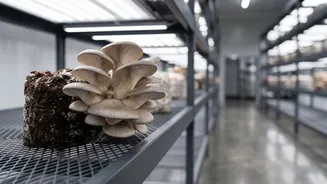
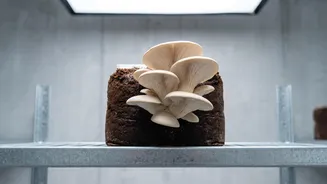
The process of turning coffee grounds into fresh mushrooms is surprisingly straightforward, making it ideal for urban environments. Growers collect fresh spent grounds from local cafés, ensuring they are used within about 24 hours to prevent mould. After cooling to room temperature, the grounds are mixed with mushroom spawn—which is essentially the root structure of the fungus, called mycelium. This mixture is then packed into special grow bags or buckets with small holes for air exchange. These containers are kept in a dark, humid, and temperature-controlled environment, which could be anything from a small room to a repurposed shipping container. Over the next few weeks, the white, thread-like mycelium completely colonizes the dark coffee grounds. Once fully colonised, a change in conditions—like exposure to more light and fresh air—triggers the mycelium to produce mushrooms, a process called ‘fruiting’. In a matter of days, clusters of fresh oyster mushrooms erupt and are ready for harvest.
The Land-Saving Advantage
This is where the model’s true genius for urban centres becomes clear. Conventional agriculture is land-intensive. Mushroom cultivation, on the other hand, requires no soil and very little horizontal space. Because the grow bags or buckets can be stacked vertically on shelves, a small footprint can yield a significant harvest. This vertical farming approach allows food to be grown in the heart of the city, in basements, warehouses, or unused indoor spaces. By cultivating food in dense urban areas, this method drastically reduces the need for vast tracts of agricultural land elsewhere. It also slashes the carbon footprint associated with transporting food over long distances from rural farms to city consumers. It represents a fundamental shift towards producing food exactly where it is consumed.
A Circular Economy in Action
This practice is a perfect real-world example of a circular economy. It takes a product previously defined as 'waste' and transforms it into a valuable, nutritious food source. The benefits ripple outwards, creating a closed-loop system. Local cafés reduce their disposal costs, urban farmers gain a free and effective growing medium, and city residents get access to fresh, locally grown produce. But the cycle doesn't even end there. After the mushrooms have been harvested two or three times, the leftover substrate—now enriched by the mycelium—is an incredibly potent compost. It can be used to enrich soil in urban gardens and parks, completing the journey from a cup of coffee back to the earth. This model offers a blueprint for sustainable entrepreneurship, especially for young people in Indian cities looking to build green businesses.