


An Inflatable Space Umbrella
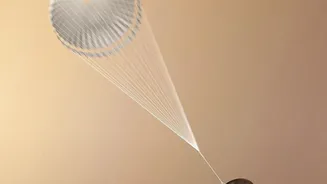
Imagine trying to land a heavy payload on Mars. The planet's thin atmosphere makes slowing down incredibly difficult. Traditional rigid heat shields, the kind used since the Apollo era, are limited by the size of the rocket fairing they launch in. This
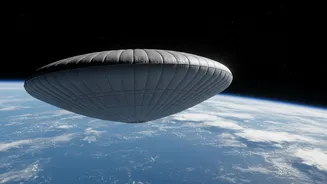
physical constraint puts a cap on how big and heavy a payload can be. This is where the Hypersonic Inflatable Aerodynamic Decelerator (HIAD) comes in. It’s a revolutionary technology that functions like a giant, durable umbrella that inflates just before entering an atmosphere. Stowed compactly during launch, it can be deployed to a much larger size than any rigid shield, creating more drag to slow the spacecraft far more efficiently. This allows the deceleration process to begin higher in the atmosphere, where the air is thinner, leading to lower peak heating and a gentler descent.
Surviving the Inferno
But how can something inflatable survive temperatures that can reach thousands of degrees? The secret lies in advanced materials. The outer layer of the shield is typically a flexible thermal protection system made of advanced ceramic fabrics, like silicon carbide woven into a cloth. This material can withstand the extreme heat of re-entry. Beneath this protective skin are multiple layers of high-tech insulation designed to stop that heat from reaching the inflatable structure itself. The inflatable part is made of stacked rings, or tori, constructed from synthetic polymers that are, by weight, many times stronger than steel. These rings are inflated with a gas, like nitrogen, to form a sturdy, rigid structure that maintains its shape even under the immense pressure and aerodynamic forces of hypersonic speeds.
Bigger, Better, and More Capable
The advantages of inflatable heat shields are transformative for space exploration. The primary benefit is the ability to land much larger and heavier payloads. While current technology can land about 1.5 metric tons on Mars—the equivalent of a golf cart—HIAD technology could enable the landing of 20 to 40 metric tons, comparable to a fully furnished house. This is essential for future human missions, which will require landing habitats, life support systems, and ascent vehicles. Furthermore, by allowing spacecraft to decelerate at higher altitudes, these shields open up new landing zones on Mars, including scientifically interesting highland regions that are currently inaccessible because the atmosphere is too thin for conventional landers to slow down safely. This technology isn't just for Mars; it could be used for missions to Venus, Titan, or for returning large components, like reusable rocket engines, to Earth.
From Test Flights to Future Missions
This isn't just a theoretical concept. NASA and its partners, including the United Launch Alliance (ULA), have been developing and testing this technology for years. A key demonstration was the Low-Earth Orbit Flight Test of an Inflatable Decelerator (LOFTID) mission in late 2022. A 6-meter diameter inflatable aeroshell was successfully launched, inflated, and survived a fiery re-entry through Earth's atmosphere at speeds of nearly 8 kilometers per second. The successful recovery of the LOFTID vehicle provided invaluable data, proving the technology's structural and thermal performance under real-world conditions. This success has paved the way for its use in future missions. ULA is considering using the technology to recover the engines of its Vulcan rocket, and it is seen as a critical enabling technology for ambitious sample return missions and eventual human exploration of Mars in the 2030s and beyond.