

Seeing in a New Light
To understand a planet as complex as Saturn, scientists need to look beyond what the human eye can see. Telescopes like the Hubble and James Webb Space Telescope observe the universe in different wavelengths, including infrared light. This allows them
to peer through the planet's hazy upper atmosphere and measure temperature, which is key to understanding weather. By capturing images in infrared, astronomers can essentially create a thermal map of Saturn, revealing how different parts of its atmosphere heat up and cool down. This has led to a major breakthrough in understanding the role of the planet's most famous feature: its rings.
A Shadow Play of Cosmic Proportions
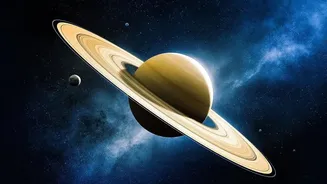
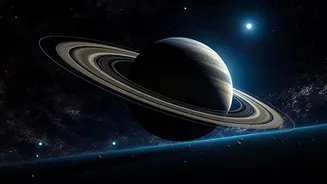
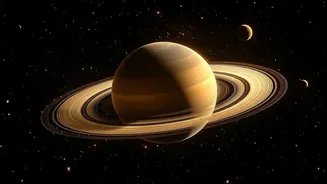
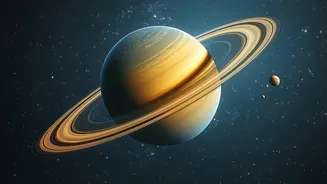
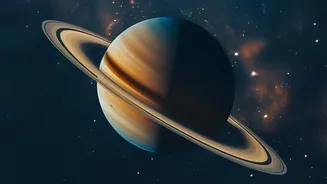
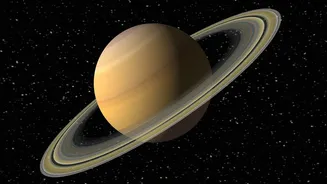
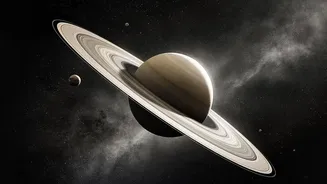
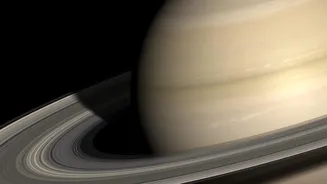
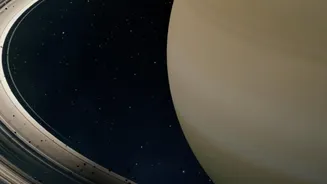
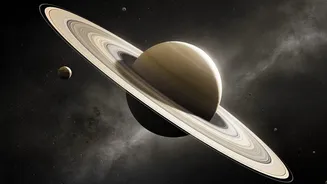
Just like Earth, Saturn has an axial tilt of about 27 degrees, which is what causes its seasons. But Saturn has a unique feature that makes its seasons extreme: its vast, dense rings. As Saturn orbits the Sun on its 29.5-year journey, the angle of its tilt changes. This causes the rings to cast enormous shadows across the planet's surface. During the winter in one hemisphere, that part of the planet is not only tilted away from the Sun but is also plunged into the deep shade of the rings, blocking even more sunlight and causing extreme cooling. These are not just small shadows; they can cover huge portions of the planet, essentially acting as a massive climate control system.
From Cooling to Chaos
This dramatic cooling effect has profound consequences for Saturn's weather. The significant temperature difference between the sunlit and shadowed regions drives powerful atmospheric dynamics. Data from missions like Cassini showed that as the ring shadow moves across the planet with the changing seasons, the atmosphere responds rapidly. Regions emerging from the shadow in the spring warm up incredibly quickly, with temperature swings of up to 14 degrees Fahrenheit. This sudden change in temperature can create instability in the atmosphere, potentially triggering the formation of massive storms that can encircle the entire planet. One such 'Great Springtime Storm' observed years ago left traces that are still visible today, highlighting the long-lasting impact of this seasonal process.
More Than Just Shadows
The rings influence Saturn's atmosphere in other surprising ways, too. Besides blocking sunlight, the rings also actively contribute material to the planet. Scientists have found evidence of 'ring rain', where icy particles from the rings are pulled down into Saturn’s upper atmosphere by its magnetic field. This phenomenon, detected as an excess of ultraviolet radiation from hot hydrogen, actually heats the upper atmosphere in the regions where it falls. This unexpected interaction between the rings and the atmosphere adds another layer of complexity to the planet's climate system, influencing both its temperature and chemical composition. It means the rings are not just a passive feature but an active participant in shaping the planet's environment.
Why This Cosmic Weather Report Matters
Studying the intricate dance between Saturn's rings, shadows, and atmosphere does more than just satisfy our curiosity about a distant world. It provides a unique natural laboratory for understanding how gas giant planets work. The processes driving Saturn's seasons—from temperature gradients to atmospheric composition changes—help scientists refine their models of planetary climates. This knowledge can be applied to better understand Jupiter, Neptune, and even the thousands of gas giant exoplanets discovered orbiting other stars. Each new observation from Hubble and Webb gives us a clearer picture of the powerful forces that shape planets, including, in some small way, our own.