


Our Sun is a dynamic and often violent star. In a major leap for solar science, a collaboration between Indian and European space missions is providing an unprecedented look at the chaotic birth of solar storms, changing how we see our star.
A Unique Partnership in Space
At the heart
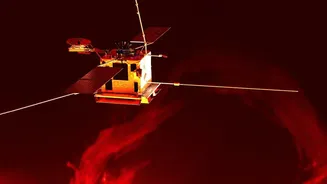
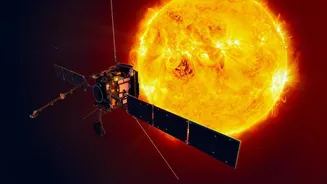
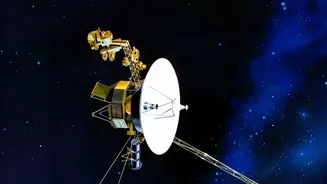
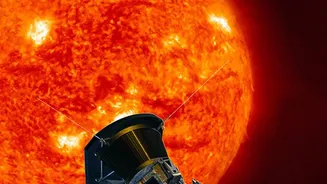
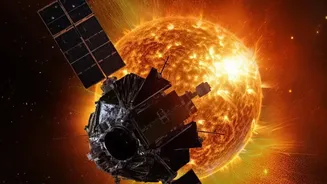
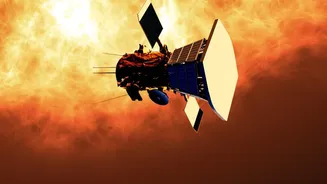
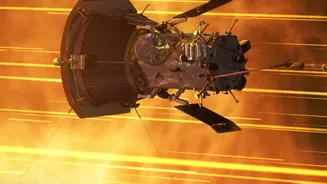
of this breakthrough are two technologically advanced missions: India's Aditya-L1 and the European Space Agency's (ESA) Proba-3. Launched by the Indian Space Research Organisation (ISRO), Aditya-L1 is the nation's first dedicated solar observatory, parked at a strategic point 1.5 million kilometres from Earth to maintain a constant watch on the Sun. Its key instrument, the Visible Emission Line Coronagraph (VELC), doesn't just take pictures; it performs spectroscopy to measure the temperature, speed, and density of the Sun's erupting plasma. Complementing this is ESA's Proba-3, a revolutionary mission also launched by an ISRO PSLV rocket. It uses two satellites flying in precise formation, about 150 metres apart, to create a perfect artificial eclipse. This allows its powerful coronagraph to capture incredibly sharp images of the Sun's faint inner corona, a region notoriously difficult to observe.
What Are Coronal Mass Ejections?
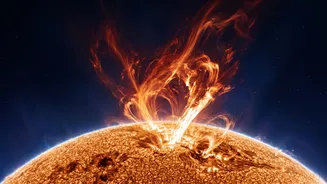
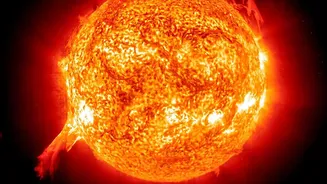
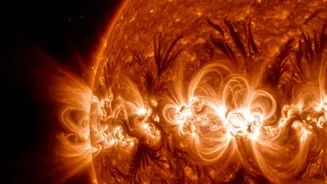
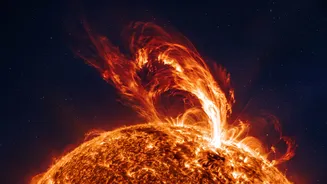
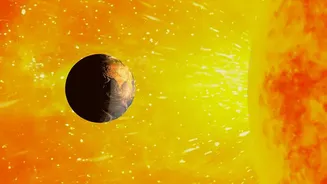
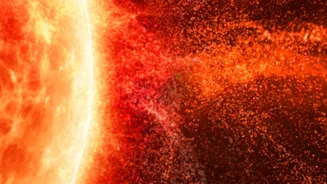
Coronal Mass Ejections (CMEs) are colossal explosions from the Sun's atmosphere, or corona. They blast billions of tonnes of magnetised plasma into space at immense speeds. While many miss our planet, those directed at Earth can have serious consequences. These solar storms can trigger intense geomagnetic storms that disrupt satellite operations, threaten astronauts, damage communication and GPS navigation systems, and even destabilise electrical power grids on the ground. Understanding how CMEs form and accelerate in their first moments is therefore crucial for improving space weather forecasts, giving us more time to prepare for their potential impact.
First Glimpses of Early Evolution
The collaboration has yielded its first major results by jointly analysing two CMEs that occurred in September 2025. For the first time, scientists combined Proba-3's crisp images with Aditya-L1's detailed spectroscopic data. The imaging from Proba-3 revealed the eruption's shape and mass, while VELC's data provided independent measurements of the plasma's density and thermal energy. This combined view allowed the team to build a much more complete picture of how the CME's energy was distributed between motion, heat, and its magnetic field right after it erupted. The two CMEs studied showed very different behaviours—one was fast and the other much slower—providing valuable new constraints on the physical processes that drive their early development.
The Latest Finding: An Uneven Expansion
Building on this momentum, the latest findings from Aditya-L1, announced in early November 2026, have challenged another longheld assumption about CMEs. Previously, these eruptions were often modelled as expanding symmetrically, like a uniform bubble. However, by using VELC's unique ability to measure motion both toward and away from the observer, scientists discovered that a CME observed in August 2024 expanded asymmetrically. Different parts of the eruption moved at different speeds, creating an uneven shape in its initial moments. This nonuniform expansion can significantly affect how the CME travels through space and its eventual arrival time and impact at Earth, making this discovery a gamechanger for space weather prediction.
Why This Matters for India and the World
These discoveries are more than just academic curiosities. With humanity's increasing reliance on spacebased technology, the ability to accurately forecast space weather is a critical global priority. The synergistic use of AdityaL1 and Proba3 demonstrates the power of international collaboration in tackling complex scientific challenges. For India, these results cement AdityaL1's position as a worldclass solar observatory and showcase the nation's growing leadership in space science. The insights gained are a vital step toward protecting our technological infrastructure from the Sun's powerful outbursts, from the satellites in orbit to the power grids on the ground.