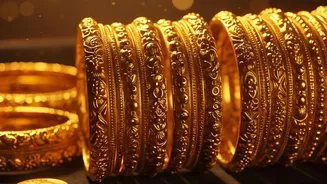








The festive season brings a familiar glitter to Indian markets: the gleam of gold. Jewellers roll out tempting offers, with discounts on making charges taking centre stage. But what do these deals truly mean for your wallet? Let's look closer.
First, What Are Making Charges?
Before you
can appreciate the discount, you need to understand the charge itself. When you buy a piece of gold jewellery, you're paying for two things: the value of the gold and the cost of turning that raw gold into an ornament. This second cost is the 'making charge'. It covers the labour of the artisan, the intricacy of the design, and other overheads. Making charges aren't standardised; they vary from one jeweller to another and even from one design to another. Typically, they are calculated in two ways: as a percentage of the gold's value (ranging from 3% to over 25%) or as a flat rate per gram. Simple, machine-made items like basic chains have lower making charges, while intricate, handcrafted pieces command much higher rates.
Decoding the Festive 'Discount'
During festivals like Dhanteras and Diwali, you'll see advertisements for 'Flat 50% Off on Making Charges' or 'Up to 30% Off'. A flat discount is straightforward—if the making charge is 20%, a flat 50% off brings it down to 10%. However, 'up to' offers require more scrutiny. This often means the maximum discount is available only on select items, perhaps diamond-studded jewellery or pieces with less popular designs. The plain gold bangles or chains you might be eyeing could have a much smaller discount, or none at all. It’s essential to ask the jeweller which specific items the advertised discount applies to.
The Difference Between Plain and Studded Jewellery
Making charges differ significantly based on the type of jewellery. Plain gold items generally have lower making charges compared to pieces studded with diamonds, emeralds, or other precious stones. This is because setting stones is a highly skilled and labour-intensive process. Consequently, discounts offered on studded jewellery might seem larger, but the base making charge is already much higher. Some jewellers even offer '100% off' on making charges for diamond jewellery, but they might recover these costs through the price of the diamonds themselves. Always ask for a clear price breakdown of the gold, stones, and making charges separately.
Don't Overlook Wastage Charges
Another important component of your bill is the 'wastage charge'. When an artisan crafts jewellery, a small amount of gold is lost in the process—as dust or tiny particles. Jewellers levy a wastage charge, typically a percentage of the gold's weight (often between 5% and 7%), to compensate for this loss. For complex handmade designs, this can be even higher. Some jewellers bundle making and wastage charges, while others list them separately. A significant discount on making charges can sometimes be offset by a high wastage charge. It is crucial to ask about both to understand the total cost above the gold's value.
How to Be a Smart Festive Shopper
To ensure you get a good deal, follow a few simple rules. First, always compare offers from a few different trusted jewellers. Don't be swayed by headline discounts alone. Second, insist on a detailed, itemised bill that clearly separates the gold price, making charges, wastage charges (if any), stone costs, and GST. This transparency is the hallmark of a reputable seller. Third, check for the BIS hallmark, which guarantees the purity of the gold. Finally, don't be afraid to negotiate. While the price of gold is fixed, making charges are often flexible, and many jewellers are open to negotiation, especially for larger purchases.