

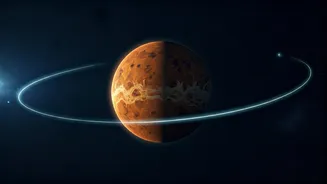



A Planet of Bizarre Extremes
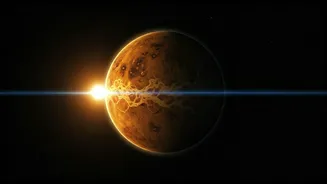
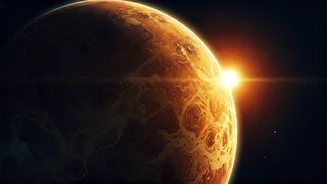
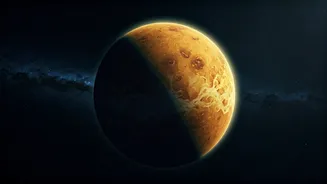
Venus is often called Earth’s “sister planet” due to its similar size and mass, but the similarities end there. It’s a world of extremes, with surface temperatures hot enough to melt lead and a crushing atmosphere 90 times denser than our own. For decades,
scientists have known about one of its strangest features: its incredibly slow rotation. New research, using years of radar observations, has now pinned down the exact length of a Venusian day with unprecedented accuracy. The findings confirm that Venus is not just slow, but its rotation speed can even vary, influenced by its thick, churning atmosphere.
A Day Longer Than a Year
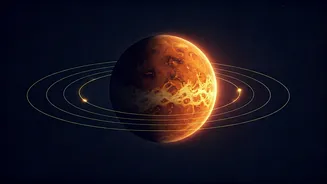
Let’s get the mind-bending numbers out of the way. It takes Venus about 225 Earth days to complete one orbit around the Sun—that’s its year. However, it takes the planet a staggering 243 Earth days to complete one rotation on its axis. This means a single day on Venus is longer than its entire year. To make things even stranger, Venus rotates backward, a phenomenon known as retrograde rotation. If you could stand on its surface, you would see the Sun rise in the west and set in the east. The new study, published in *Nature Astronomy*, measured the Venusian day at an average of 243.0226 Earth days. This precision is crucial because even tiny variations hold clues about the planet itself.
How Scientists Measured a Planet's Spin
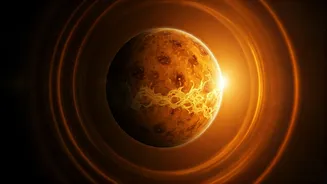
So, how do you time a planet that’s shrouded in a permanent blanket of thick, sulphuric acid clouds? You can't just watch a landmark rotate. The answer is radar. For 15 years, from 2006 to 2020, scientists used NASA’s Goldstone Antenna in California to bounce radio waves off Venus. They would then detect the returning echo using the Green Bank Observatory in West Virginia. By precisely timing how long it took for the radar signal to return and analysing the subtle distortions in the echo, they could measure the planet’s spin rate with incredible precision. Think of it like throwing a tennis ball at a spinning merry-go-round and observing how it bounces back. The spin of the target affects the return path, and by studying that, you can deduce the rotation.
The Atmosphere's Heavy Hand
The research also confirmed that the length of a Venusian day is not constant. The measurements showed variations of up to 20 minutes over the observation period. The culprit? The planet’s monstrously thick atmosphere. This dense ocean of air is in a state of constant, rapid motion, whipping around the planet in just four Earth days. This fast-moving atmosphere exerts a significant drag on the surface, exchanging momentum with the solid planet and causing it to slightly speed up and slow down. It's a powerful reminder that on Venus, the weather doesn’t just happen on the planet—it happens *to* the planet, physically altering its rotation.
Peeking Inside Venus's Core
Beyond timing its day, these precise measurements allowed scientists to probe deep inside Venus. The radar data revealed the exact tilt of Venus's axis (2.64 degrees) and the rate at which it wobbles, a motion called precession. Just as a spinning top wobbles, so do planets. This wobble rate is directly related to the planet's internal structure. By modelling the precession, the team was able to calculate the size of Venus’s core for the first time. They estimate it to be about 3,500 kilometres in radius, similar to Earth’s. The data strongly suggests the core is liquid, although it’s still uncertain if there’s a solid inner core like ours. Essentially, by studying the planet’s spin from millions of kilometres away, we can learn about its deepest, most hidden features.