




A Sweet Discovery in a Surprising Place
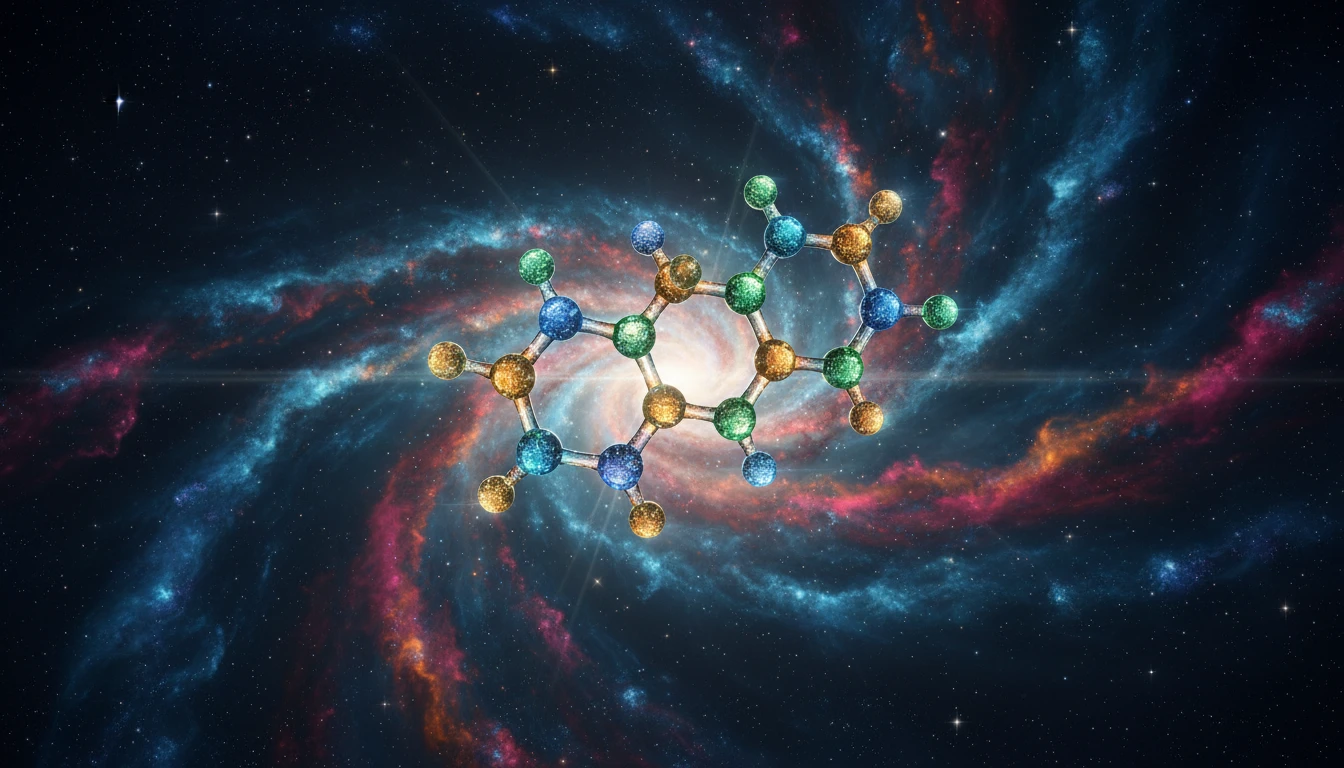
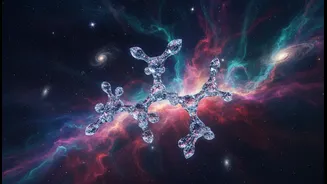
Scientists have detected erythrulose, a four-carbon sugar, floating in a vast cloud of gas and dust known as G+0.693-0.027, located roughly 27,000 light-years from Earth near the galactic center. On Earth, this simple sugar is found in small amounts in red
raspberries. While sugars like ribose and glucose have been found in meteorites that have landed on our planet, this is the first time a sugar has been directly identified in the interstellar medium—the thin-spread matter between stars. The discovery was made by an international team using powerful radio telescopes in Spain, which can detect the unique radio-wave 'fingerprints' of specific molecules. This confirms that the chemical processes in deep space are complex enough to build molecules that are direct precursors to life.
The Galactic Center's Chemical Factory
The region near the Milky Way's core, known as the Central Molecular Zone, is a chaotic but chemically rich environment. These giant molecular clouds, though frigid, are bustling chemical factories where atoms clump together on the surfaces of icy dust grains, forming ever more complex molecules. Over 340 different molecules have been identified in interstellar space, including alcohols and other organic compounds. The G+0.693-0.027 cloud is particularly noteworthy because it is rich in prebiotic molecules but shows no signs of active star formation yet, making it a pristine laboratory for studying the ingredients from which stars and planets will eventually form.
More Than Just a Simple Sugar
The detection of erythrulose is significant because it's a stepping stone to even more critical biological molecules. Sugars are the backbone of life, forming the structure of RNA and DNA and providing energy for metabolism. While erythrulose isn't a direct component of our genetic material, it's chemically related to ribose, the five-carbon sugar that is fundamental to RNA. Scientists believe that under aqueous conditions, erythrulose can be converted into other sugars that are central to prebiotic chemistry. Its discovery fuels optimism that larger, more complex sugars like ribose might also be forming in these interstellar clouds, waiting to be found.
Tracing the Cosmic Delivery Service
Finding erythrulose in interstellar space helps solve a long-standing puzzle: where did Earth's first biological building blocks come from? Many scientists believe that the harsh conditions on early Earth were not conducive to forming complex sugars efficiently. This discovery supports the theory of a cosmic delivery service. The idea is that these essential compounds formed in space, within the very molecular cloud that birthed our solar system. They were then incorporated into asteroids and comets. For billions of years, these icy bodies have acted as cosmic messengers, delivering their precious organic cargo to young planets like Earth through impacts, essentially seeding the planets with the raw materials needed for life to begin.
From Stardust to Life's Ingredients
The presence of a relatively complex sugar like erythrulose across the galaxy has profound implications. It suggests that the chemical pathway to life isn't a unique or difficult process, but a common feature of the cosmos. These molecules are not anomalies but are likely widespread, cooked up in stellar nurseries throughout the Milky Way and beyond. Every new star system that forms inherits a chemical toolkit from its parent cloud, complete with the prebiotic molecules—like sugars and amino acid precursors—that could potentially kickstart biology. This dramatically increases the possibility that the ingredients for life are not just present, but abundant throughout the universe, making the prospect of life elsewhere that much more plausible.