



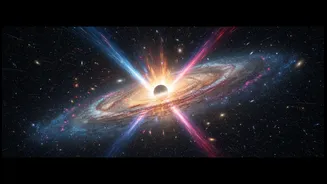


A Sleeping Giant Stirs
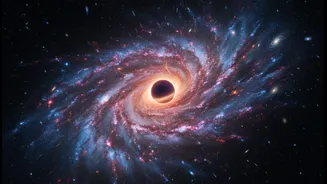
Deep in the constellation Virgo, about 300 million light-years away, lies a galaxy with the unassuming name SDSS1335+0728. For decades, it was just another faint smudge in telescope images. Then, in late 2019, something extraordinary happened: its core
began to shine with astonishing intensity, and it has only gotten brighter since. Astronomers believe they are seeing, for the first time in real time, the activation of the supermassive black hole at its heart. Most supermassive black holes, including the one in our own Milky Way, are dormant or 'sleeping', meaning they aren't actively consuming large amounts of material. This dramatic awakening offers a rare chance to study how these cosmic monsters switch on and begin to feast.
What is Cosmic Activation?
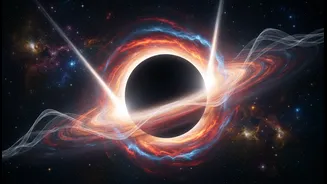
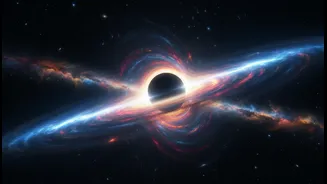
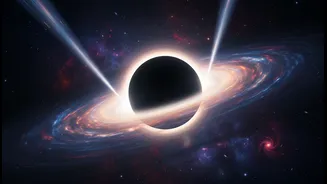
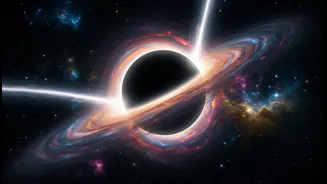
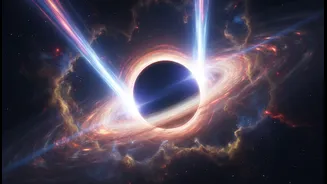
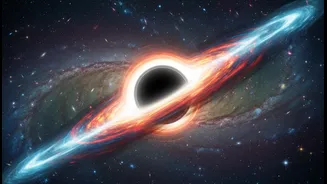
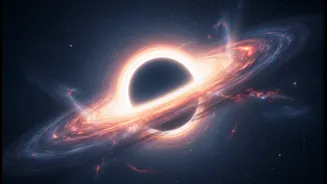
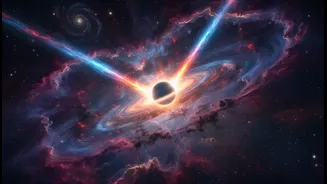
This sudden 'turning on' is what scientists call the formation of an Active Galactic Nucleus, or AGN. An AGN is an extremely bright, compact region powered by a supermassive black hole actively feeding on its surroundings. The process begins when a large amount of gas or dust gets too close to the black hole. Pulled in by immense gravity, this material doesn't fall in directly but forms a swirling, superheated structure called an accretion disk. Friction within this disk heats the matter to millions of degrees, causing it to glow intensely across the entire light spectrum, from X-rays to radio waves. This brilliant output is the 'activation' that has transformed the galaxy's core from a quiet region into one of the most luminous objects in the universe.
A Galactic Makeover
The activation has completely altered the environment around the black hole. Data collected since 2019 shows the galaxy has become four times brighter in ultraviolet light, doubled its brightness in mid-infrared wavelengths, and, as of February 2024, started emitting X-rays. This flood of radiation is a direct consequence of the newly formed, furiously glowing accretion disk. The intense energy output from an AGN can have profound effects on the host galaxy, potentially pushing gas out and influencing the rate of star formation millions of light-years away. Observing this process from the very beginning allows scientists to test their theories about how a black hole's diet changes its cosmic neighbourhood.
Why This Discovery Is Unprecedented
While astronomers have seen galaxies brighten suddenly before, these events—like a star being torn apart (a tidal disruption event) or a supernova—are typically short-lived, lasting for a few hundred days at most. The brightening of SDSS1335+0728 has continued for more than four years, making it a unique and sustained event. According to Paula Sánchez Sáez, an astronomer at the European Southern Observatory, this is the first time the activation of a massive black hole has been observed as it happens. This real-time observation provides a 'before and after' picture that has been missing from our understanding of galaxy evolution. It allows scientists to move from studying the long-term results of black hole activity to witnessing the cause and effect as it unfolds.