
A Wave of New Evidence
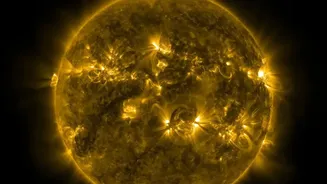
Using the powerful Daniel K. Inouye Solar Telescope in Hawaii, scientists have captured the most detailed images of the Sun's surface ever taken. These remarkable observations, published in the journal Nature, revealed tiny, swirling vortices of plasma
at the edges of solar granules—the bubbling, Texas-sized cells of hot gas that cover the Sun's surface. These whirlpool-like structures are signs of a phenomenon known as the Kelvin-Helmholtz instability, which occurs when two fluids flowing at different speeds meet. While this effect is seen in clouds and oceans on Earth, observing it on the Sun's surface is a major breakthrough.
The Sun's Hottest Mystery
For decades, one of the biggest puzzles in solar physics has been the coronal heating problem. The Sun's surface, or photosphere, is about 6,000 degrees Celsius, but its atmosphere, the corona, sizzles at over a million degrees. This defies basic thermodynamics; typically, the farther you move from a heat source, the cooler it gets. Scientists have long theorized that some mechanism must be actively pumping energy from the surface up into the corona, and waves in the Sun's plasma have been a leading suspect. The challenge has been finding direct evidence of a process powerful enough to do the job.
Riding the Plasma Wave Upward
The newly discovered vortices act as a crucial link. They demonstrate how kinetic energy from the churning surface can be converted into twisting magnetic tension. This process, the Kelvin-Helmholtz instability, creates turbulence and waves that can travel upwards along the Sun's magnetic field lines, carrying energy with them. Think of it like snapping a rope: the wave travels along the rope, carrying energy from your hand to the other end. In this case, the swirling plasma on the surface snaps the magnetic field lines, sending energy shooting up into the incredibly thin solar atmosphere.
From Tiny Whirlpools to Giant Flares
Understanding this upward energy transport isn't just about solving a cosmic riddle. The same magnetic energy, when built up, can lead to explosive events like solar flares and coronal mass ejections. These outbursts create 'space weather'—streams of charged particles that can travel across the solar system and disrupt satellites, power grids, and communication systems here on Earth. By observing how energy is transferred at these incredibly small scales, scientists can build better models to predict when and how the Sun might unleash these larger, more disruptive events. The vortices are seen as key 'motors' for this magnetic energy buildup.
A New Era of Solar Observation
This discovery was only possible because of the unprecedented resolution of the Daniel K. Inouye Solar Telescope, which can resolve features on the Sun as small as 20 kilometers across. It highlights how technological advancements are opening new windows into understanding our star. Scientists can now directly observe physical processes that were previously only theoretical. This new ability to connect the small-scale churning on the surface with the large-scale dynamics of the corona marks a significant step forward. Future research will focus on quantifying just how much energy these waves transport and how they contribute to the overall heating of the corona and the acceleration of the solar wind.