



How to Sail on Sunshine
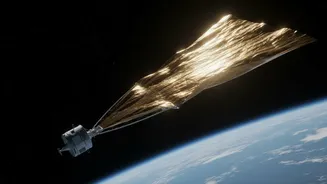
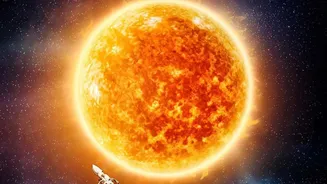
The concept behind a solar sail is elegant and surprisingly simple. It relies on the fact that light, though it has no mass, carries momentum. When particles of light, called photons, stream from the Sun and strike a large, reflective surface, they transfer
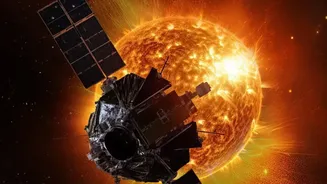
a tiny bit of their momentum. This creates a gentle but continuous push, known as solar radiation pressure. While the force from a single photon is minuscule, the constant stream from the Sun adds up. Over weeks and months, a spacecraft with a large enough sail can accelerate to tremendous speeds without using a single drop of propellant. This is the key advantage: unlike chemical rockets that provide a powerful but short-lived burn, solar sails offer endless acceleration as long as they are exposed to sunlight.
The Latest Breakthrough
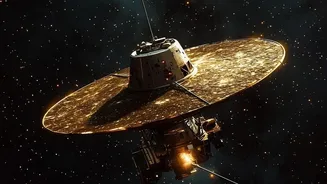
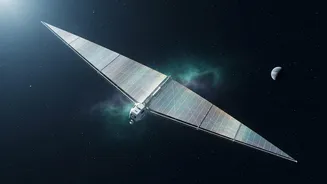
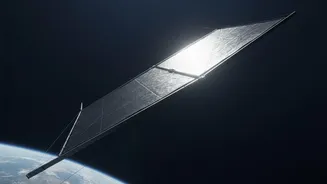
The headline-making progress comes from NASA's Advanced Composite Solar Sail System, or ACS3. This mission was designed specifically to test new materials and deployment technologies crucial for making solar sails bigger and lighter than ever before. The ACS3 mission successfully deployed its 80-square-meter sail—roughly the size of a small apartment—from a spacecraft no bigger than a microwave oven. The critical innovation being tested is the use of new lightweight carbon fibre composite booms to support the sail. These booms are not only significantly lighter than previous metal versions but are also more resistant to warping in the extreme temperatures of space. The successful deployment of these booms is a major validation, proving that massive sails can be packed into a small volume for launch and then reliably unfurled in space. This demonstration paves the way for future sails that could be as large as a hockey rink or even bigger.
Faster, Cheaper, Farther
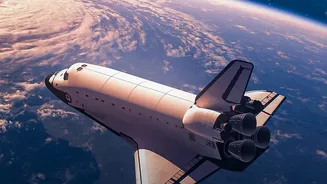
The implications of this technology are enormous. By eliminating the need for heavy, expensive, and finite propellant, solar sails can dramatically lower the cost of missions. This opens the door for more ambitious projects, from asteroid reconnaissance to placing early warning satellites for space weather closer to the Sun. But the most exciting advantage is speed. While the initial acceleration is slow, the constant push allows a solar sail-powered craft to eventually overtake conventional rockets. Projections suggest that advanced solar sails could reach speeds five to ten times faster than spacecraft like the space shuttle. At such velocities, a probe could potentially reach the outer planets in a matter of months instead of years. Some concepts even envision using powerful Earth-based lasers to give the sails an extra push, theoretically accelerating tiny probes to a fraction of the speed of light for interstellar journeys.
Navigational Challenges and Next Steps
Of course, the technology is still in its early stages. One of the main challenges is navigation. Steering a craft using only light pressure requires incredibly precise adjustments to the sail's angle relative to the Sun. The recent ACS3 mission encountered minor issues, including a slight bend in one of its booms and a slow tumble after deployment, which the mission team is currently working to correct. These are the kinds of real-world problems that technology demonstrations are designed to identify and solve. As the sail gets farther from the Sun, the sunlight weakens, and the acceleration diminishes. Future missions will need to perfect control systems and perhaps use gravitational assists from planets to help steer and accelerate. Despite the hurdles, the successful test of the composite booms is a critical step forward, providing invaluable data for the next generation of even larger sails.