



A New Class of Worlds
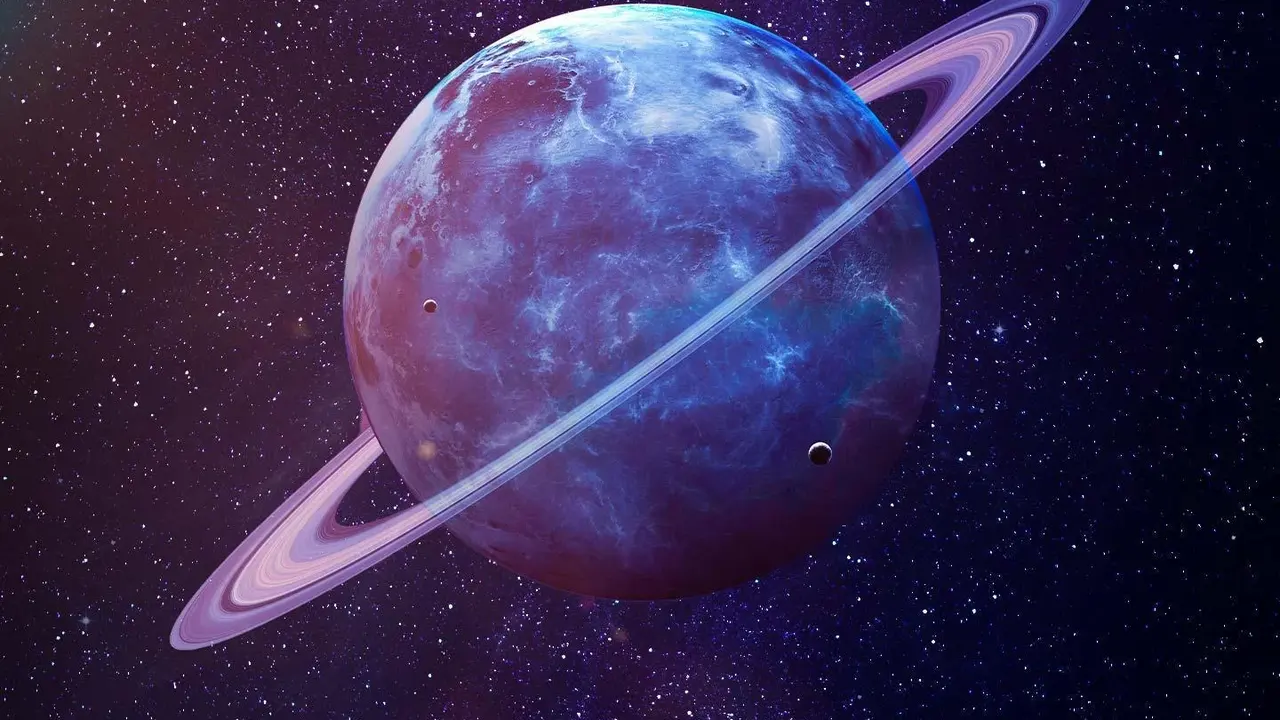
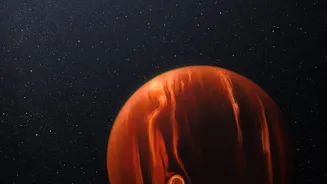
Imagine a planet larger than Earth but smaller than our own Neptune, orbiting its star at a temperature that is balmy compared to the frozen outer reaches of our solar system, yet not scorching hot. This is the realm of 'warm Neptunes' and 'sub-Neptunes',
a class of planets that are among the most common in our galaxy but absent from our own cosmic neighbourhood. Recent observations with the James Webb Space Telescope (JWST) have targeted worlds like these, including WASP-107b and the much-discussed K2-18 b. These planets are not small, rocky worlds like Earth, but gaseous planets with thick, hydrogen-rich atmospheres, making them fascinating, and difficult, targets for study. Finding out what their atmospheres are made of is a crucial first step in understanding how these common planets form and whether they could, against all odds, harbour unique environments.
The Hunt for a Tell-Tale Gas
Detecting anything in the atmosphere of a planet light-years away is a monumental challenge. Astronomers rely on a technique called transit spectroscopy. When an exoplanet passes in front of its host star from our perspective, a tiny fraction of the starlight filters through the planet's atmosphere. The gases present absorb specific colours, or wavelengths, of light, leaving a chemical fingerprint that powerful instruments like the JWST can read. Methane (CH4), the simplest organic molecule, has long been on the wish list for detection because it's so significant in our own solar system. For years, it proved elusive in transiting exoplanets. However, recent, definitive detections of methane in the atmospheres of planets like WASP-80 b and K2-18 b represent a massive technical victory. It confirms that our premier space telescope can sniff out key molecules even on worlds very different from our own.
Why Methane Is So Exciting
The excitement around methane comes from its dual identity. On one hand, it can be produced by purely geological processes like volcanic activity. On the other hand, on Earth, the vast majority of methane in our atmosphere is produced by life—from microbes in wetlands to cows in fields. Because methane is quickly broken down by sunlight, its continued presence in an atmosphere means it must be constantly replenished. Finding a planet with a lot of methane, especially alongside other gases like carbon dioxide but with very little carbon monoxide, could be a compelling sign of biological activity. While no one is claiming to have found alien life, finding methane is a critical piece of the puzzle. It’s considered one of the most promising 'biosignatures' that the JWST is capable of detecting.
A Proving Ground for Bigger Questions
Detecting methane on a warm Neptune is less about the planet itself and more about what the discovery represents. These gassy planets are not prime candidates for life as we know it. Some, like K2-18 b, are theorised to be 'Hycean' worlds with potential water oceans under their vast hydrogen atmospheres, but this is still debated. The real breakthrough is the demonstration of capability. These atmospheres are challenging to observe. Successfully identifying methane and other molecules proves that the tools and methods work under difficult conditions. It’s like a dress rehearsal. If astronomers can successfully map the atmosphere of a puffy, hazy warm Neptune, it gives them enormous confidence that they can do the same for smaller, rockier, more Earth-like planets that are considered better candidates for hosting life.
Not Aliens, But a Clear Roadmap
It’s important to be clear: these methane detections are not evidence of life. The recent findings on planets like WASP-107b and K2-18 b are being used to understand the planets' formation and internal heat, which can explain the unexpected methane levels without needing biology. For example, the low amount of methane on WASP-107 b points to a very hot interior and vigorous atmospheric mixing. The presence of methane and carbon dioxide on K2-18 b, along with a lack of ammonia, is consistent with the Hycean world hypothesis. More intriguing was a tentative hint of dimethyl sulfide (DMS) on K2-18 b, a gas that on Earth is only produced by life, though this signal is not yet confirmed. The true breakthrough is that we have moved from speculating about biosignatures to actively gathering the data needed to interpret them. We now have a roadmap for how to analyse these worlds.