





A Celestial Game of Hide-and-Seek
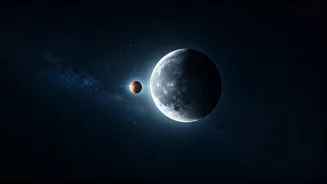
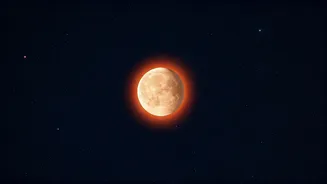
This isn't just a case of two celestial objects appearing near each other in the sky. What's happening is a far more precise and captivating event known as a lunar occultation. Think of it as a mini-eclipse, but instead of the Moon covering the Sun, it will
pass directly in front of a distant star. For a brief period, the massive, fiery Antares will vanish behind the Moon's dark limb, only to reappear on the other side. Because the Moon has no atmosphere, the star's light won't fade gradually; it will snap off instantly, creating a stark and beautiful moment for anyone watching.
Meet Antares: The Rival of Mars
The star at the centre of this spectacle is no ordinary flicker of light. Antares, also known as Jyeshtha in Indian astronomy, is a red supergiant and one of the largest stars visible to the naked eye. It’s so enormous that if it were placed where our Sun is, its outer edge would extend beyond the orbit of Mars and into the asteroid belt. Its name, Antares, is ancient Greek for 'rival of Ares' (Ares being the Greek god of war, equivalent to the Roman god Mars). This is because its distinct reddish hue makes it look like a celestial competitor to the planet Mars when they appear close together in the sky. Located in the heart of the constellation Scorpius, Antares is a celestial heavyweight, making its brief disappearance all the more dramatic.
When and Where to Watch in India
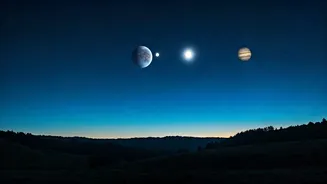
Timing is everything for an event like this. The occultation will be visible across most of India, but the exact moment of disappearance and reappearance will vary slightly depending on your location. The event is set for the evening. You should start looking towards the western or south-western sky after sunset as the sky darkens. The Moon will be a crescent, making the unlit portion difficult to see, which adds to the magic of Antares suddenly vanishing into what appears to be empty space. For major cities, the disappearance will happen roughly between 7:30 PM and 8:30 PM IST. For example, in Delhi, look for the star to disappear around 8:15 PM, while in Mumbai, it will be closer to 8:00 PM. In Bengaluru, the event will occur earlier, around 7:45 PM. The star will reappear from behind the Moon's bright, sunlit edge about an hour later, though this can be harder to spot due to the glare.
Do I Need a Telescope?
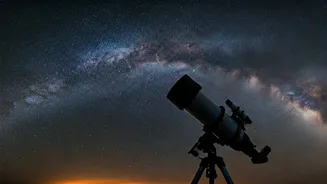
The best part about this event is its accessibility. You don’t need any fancy equipment to enjoy the basics. Antares is one of the 20 brightest stars in the night sky, and the Moon is, of course, easily visible. You can watch the star approach the Moon with just your naked eyes. However, to get the best view of the 'blink-out' moment, a pair of binoculars is highly recommended. Binoculars will stabilize the image and make the instant disappearance much clearer and more defined. They will also help you spot Antares as it gets very close to the Moon's dark limb just before it vanishes. If you have a small telescope, even better. You'll be able to watch the star’s light vanish right at the rugged, cratered edge of the Moon, offering a truly unforgettable view of celestial mechanics in action.
Why This Occultation Is Special
The Moon travels along a path called the ecliptic, regularly passing in front of stars. However, occultations of very bright stars like Antares are relatively uncommon for any given location. It requires a perfect alignment of the Earth, Moon, and the star. This event is a beautiful and tangible demonstration of our solar system's motion. It reminds us that the sky is not a static painting but a dynamic, three-dimensional space where objects are constantly moving and interacting. Watching a star hundreds of light-years away get momentarily hidden by our own natural satellite is a humbling and awe-inspiring experience that connects us directly to the grandeur of the cosmos.