




What is a Dark Sky Reserve?
A Dark Sky Reserve is a designated area that actively works to minimise light pollution. The goal is to preserve the natural darkness of the night, creating an environment with exceptional views of the stars and celestial bodies. These reserves typically
have a dark core zone, where the sky is most pristine, surrounded by a peripheral area where policies are in place to control artificial lighting. It's a commitment to protect our view of the cosmos not just for scientific purposes but for cultural heritage, education, and public enjoyment. Hanle's designation is a landmark achievement, marking it as India's first official Dark Sky Reserve.
The Birth of a Cosmic Sanctuary in Ladakh
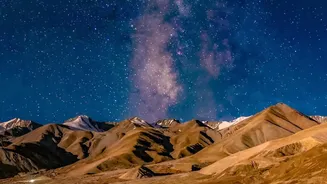
The Hanle Dark Sky Reserve was officially established in December 2022, a collaborative effort between the Union Territory of Ladakh administration, the Ladakh Autonomous Hill Development Council (LAHDC), and the Indian Institute of Astrophysics (IIA). Located within the Changthang Wildlife Sanctuary, the reserve spans a radius of approximately 22 kilometres around the village of Hanle. Its location is no accident. Situated on the Changthang Plateau at an altitude of 4,500 metres (about 14,764 feet), Hanle is a cold, dry desert with over 270 clear, cloudless nights a year, making its skies among the best in the world for observing the universe.
A Global Hub for Astronomical Science
Long before it became a tourist destination, Hanle was a prized location for scientists. It is home to the Indian Astronomical Observatory (IAO), one of the highest observatories on the planet, operated by the IIA. Established in 2001, the observatory houses the powerful 2-metre Himalayan Chandra Telescope, among other instruments. The site's high altitude, thin atmosphere, and minimal atmospheric moisture provide ideal conditions for optical, infrared, and gamma-ray astronomy, allowing researchers to study distant galaxies, black holes, and supernovas with remarkable clarity. The Dark Sky Reserve was created in large part to protect these world-class scientific facilities from the threat of increasing light pollution.
Astro-Tourism and Community Empowerment
The Hanle Dark Sky Reserve is more than just a scientific outpost; it's a pioneering model for sustainable development. A key objective of the project is to foster astro-tourism, creating new economic opportunities for the local Changpa community, who traditionally rely on pastoralism. The IIA and local administration have trained dozens of residents, many of them women, to become 'Astronomy Ambassadors'. Equipped with telescopes and knowledge of the night sky, these guides offer stargazing sessions to visitors. This initiative has led to a boom in homestays, providing a new source of income that is both sustainable and respectful of the local culture and fragile environment.
What a Stargazer Can See
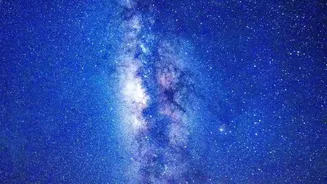
For visitors who make the journey to this remote corner of Ladakh, the reward is a celestial spectacle of unparalleled grandeur. Hanle's sky is rated Bortle 1, the darkest classification possible, a status held by only a few places on Earth. On a clear, moonless night, the Milky Way is not a faint band but a brilliant, detailed river of light stretching across the horizon. With the naked eye, it's possible to spot distant galaxies like Andromeda, while meteor showers and constellations appear with breathtaking clarity. Local astronomy guides help visitors navigate the cosmos with high-powered telescopes, offering close-up views of planets, nebulae, and star clusters in a sky that feels truly infinite.