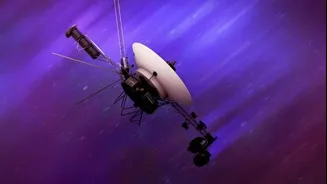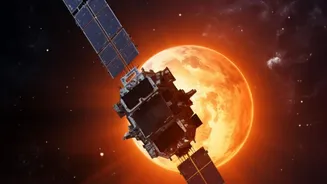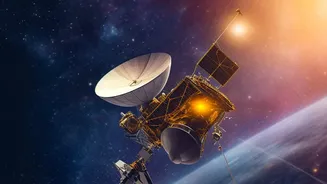


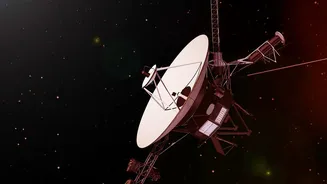

After nearly 50 years trekking through the cosmos, a tiny ambassador from Earth is about to hit an almost unimaginable milestone. NASA’s Voyager 1 spacecraft is set to become the first human-made object to reach a distance of one light-day from our planet.
What is a Light-Day?
A light-day isn't a measure of time, but of immense distance. It’s how far a particle of light travels in a vacuum in 24 hours. That equates to roughly 25.9 billion kilometres (or 16.1 billion miles). To put that into perspective, light from the Sun takes just over eight minutes to reach Earth. A radio signal sent to Voyager 1 on November 18, 2026, will take a full day to arrive, and another full day for its reply to be received by NASA's Deep Space Network. This incredible distance makes the upcoming milestone, expected on November 18, 2026, a profound moment in the history of exploration.
A Journey for the Ages
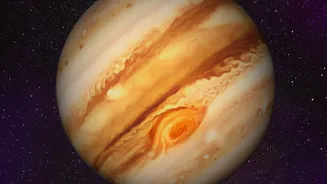
Launched on September 5, 1977, Voyager 1’s primary mission was to conduct flybys of Jupiter and Saturn. Along with its twin, Voyager 2, it revolutionized our understanding of the outer solar system. It was the first to discover active volcanoes beyond Earth on Jupiter's moon Io, and it provided detailed images of Saturn's complex ring system. After its planetary encounters, which included gravity-assist manoeuvres that slingshot it to its current high speed of about 61,000 km/h, its mission was extended. Since 1998, it has held the title of the most distant human-made object, and in August 2012, it made history by becoming the first spacecraft to enter interstellar space—the region between the stars.
Still Whispering Across the Void
Keeping a nearly 50-year-old spacecraft operational is a monumental feat of engineering. Voyager 1 operates on computer memory that is thousands of times smaller than a modern smartphone's, and its power supply, a radioisotope thermoelectric generator, dwindles by about four watts each year. To conserve energy, engineers have shut down most of its instruments, including its cameras, which took the iconic 'Pale Blue Dot' photo in 1990. Despite recent technical scares, including a five-month-long communications glitch caused by a failed memory chip, NASA engineers have managed to keep it talking. As of late 2026, two instruments remain active, studying the interstellar medium.
A Message in a Bottle
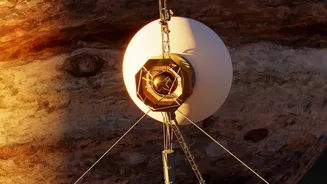
Attached to Voyager 1 is the 'Golden Record', a 12 inch gold plated copper disc intended as a message to any extraterrestrial civilization that might one day find it. Assembled by a committee led by famed astronomer Carl Sagan, the record contains a time capsule of life on Earth. It includes 116 images, a variety of natural sounds like wind and surf, music from different cultures including Bach and Chuck Berry, and spoken greetings in 55 languages. While the probe itself will likely go silent around 2036 as its power fades, the spacecraft and its Golden Record will continue their silent journey through the Milky Way for eons, a testament to human curiosity. In about 40,000 years, it will drift past the star Gliese 445.