



A Cosmic Dance of Giants
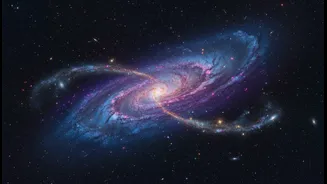
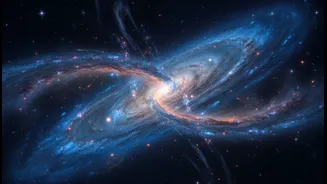
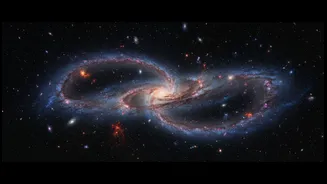
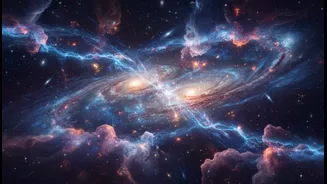
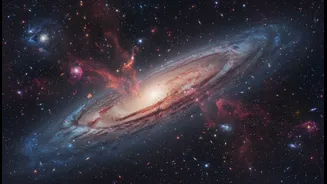
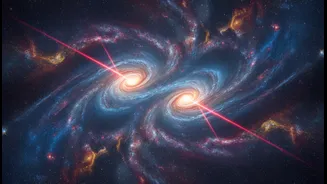
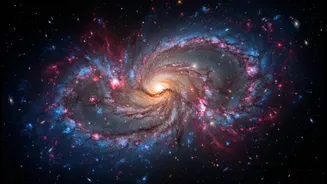
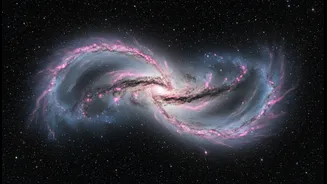
Imagine two sprawling cities of stars, gas, and dust, each hundreds of thousands of light-years across, hurtling towards each other. This is a galaxy collision. Contrary to what the name suggests, individual stars rarely, if ever, crash into one another
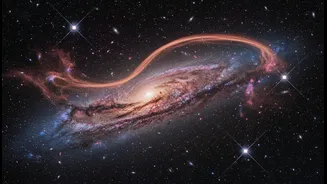
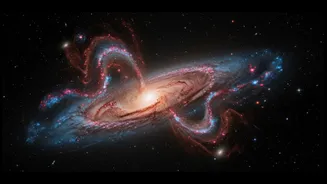
due to the immense distances between them. Instead, the two galaxies engage in a gravitational dance that can last for hundreds of millions of years. Their structures are warped and twisted, with long streamers of stars and gas being flung into intergalactic space. These mergers are a fundamental process in the universe, driving how galaxies grow and change over cosmic time. Early in the universe's history, these events were far more common and played a crucial role in building the massive galaxies we see today.
The Sleeping Giants at the Galactic Core
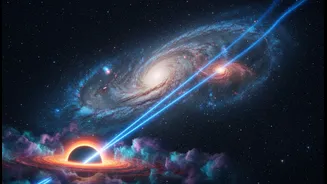
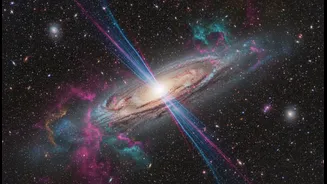
At the heart of nearly every massive galaxy, including our own Milky Way, lies a supermassive black hole—an object with millions or even billions of times the mass of our sun. For most of their lives, these giants are dormant, or quiescent. They are the quiet rulers of their galactic kingdoms, their immense gravity holding the central parts of the galaxy together. However, they are not always quiet. When they actively feed on surrounding gas and dust, they can become what astronomers call an Active Galactic Nucleus (AGN). This process unleashes an incredible amount of energy, making the galaxy's center shine more brightly than all of its billions of stars combined.
Waking the Beast: A Cosmic Delivery Service
This is where the two stories merge. A galaxy collision is the perfect mechanism to awaken a sleeping giant. The gravitational chaos of a merger disrupts the stable orbits of gas and dust clouds within the interacting galaxies. This material loses momentum and begins to fall inward, cascading towards the galactic center. Scientists have described this as a 'cosmic delivery service,' providing a huge supply of fuel directly to the supermassive black hole. Recent studies using advanced tools like the Euclid space telescope and machine learning have provided the strongest evidence yet for this connection. They show that active black holes are two to six times more common in merging galaxies than in isolated ones. The most luminous and fastest-growing black holes are almost exclusively found in the hearts of these cosmic pile-ups.
The Aftermath: Creation from Chaos
The effects of this union are profound and transformative. The same influx of gas that feeds the black hole also triggers a massive burst of star formation. As clouds of gas and dust collide and compress, they collapse to form millions of new stars, creating what is known as a starburst galaxy. Over time, the frenetic activity dies down. The black hole's feeding frenzy can eventually become so energetic that it pushes remaining gas out of the galaxy, shutting off further star formation—a process called AGN feedback. The two galaxies eventually coalesce into a single, larger galaxy. Often, two spiral galaxies will merge to form a large, elliptical galaxy, now dominated by older stars and a much larger, more massive central black hole. This entire process is a key part of the lifecycle of galaxies, explaining how they evolve from star-forming spirals to massive ellipticals.