



The Cosmic Speed Limit
Everything in the universe has a speed limit, and nothing can travel faster than light. This ultimate cosmic speed is a staggering 2,99,792 kilometres per second. To put that in perspective, a beam of light could circle the Earth more than seven times
in a single second. It’s almost unimaginably fast, but in the vast emptiness of space, even this incredible speed isn’t enough for light to travel instantaneously. Space is just that big.
An Eight-Minute Delay
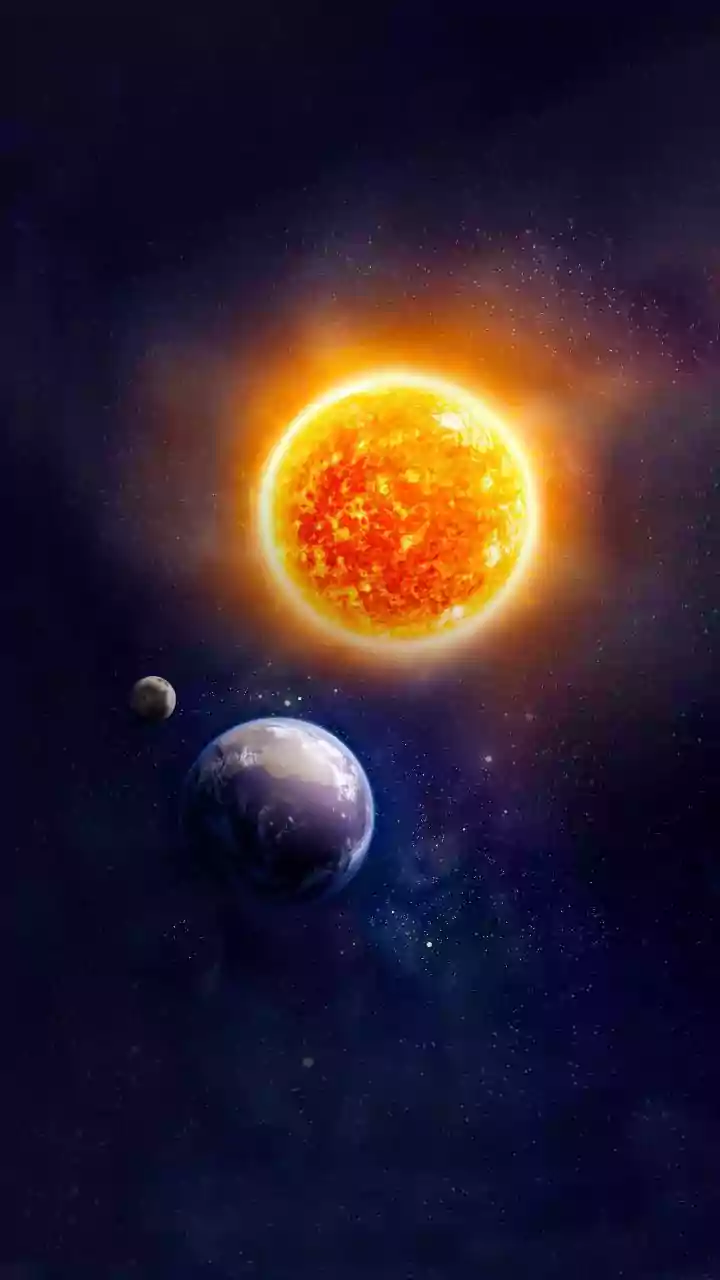
Our sun is, on average, about 150 million kilometres away from Earth. It’s a distance so vast that our minds struggle to grasp it. When you divide that enormous distance by the speed of light, you get a travel time of approximately 500 seconds. That translates to about 8 minutes and 20 seconds. So, every single photon—every particle of light—that leaves the surface of the sun must travel across the solar system for over eight minutes before it can reach our planet, pass through our atmosphere, and finally end its journey on your skin. You are, quite literally, being touched by a sun that existed eight minutes ago.
The Real Journey Was Much Longer
While the eight-minute trip from the sun's surface to Earth is impressive, it’s just the final leg of a much, much longer journey. The photons that warm you today didn't just appear on the sun's surface. They were born deep within the sun's incredibly dense core through nuclear fusion. From there, a photon begins a chaotic, zigzagging path to escape. It collides with other particles, gets absorbed, and is re-emitted in a random direction over and over again. This process, known as a 'random walk,' can take a single photon anywhere from 10,000 to 1,70,000 years to travel from the core to the surface. The eight-minute sprint to your window is the very last, triumphant moment of a journey that began before human civilization as we know it.
Living in the Sun's Past
This eight-minute delay has a mind-bending implication: we never see the sun as it is, but as it was. If the sun were to suddenly and magically vanish, we would have no idea for 8 minutes and 20 seconds. Life on Earth would continue as normal, bathed in the light of a star that was no longer there. This principle is our window into the history of the universe. The light from Proxima Centauri, the next nearest star, takes over four years to reach us. When we look at the Andromeda Galaxy, we are seeing it as it was 2.5 million years ago. The light from the most distant galaxies has been traveling for billions of years, giving us a picture of the early universe. Our sun’s eight-minute delay is our most intimate and personal connection to this fundamental truth of cosmology.